
Connectivity isn’t a luxury anymore—it’s the foundation every business runs on. When your network is slow, unreliable, or struggling to keep up with data demands, everything suffers. Projects stall. Teams get frustrated. Customers notice. That’s why more businesses, campuses, and data centers are making a decisive shift toward a solution that simply performs: fiber optic cabling.
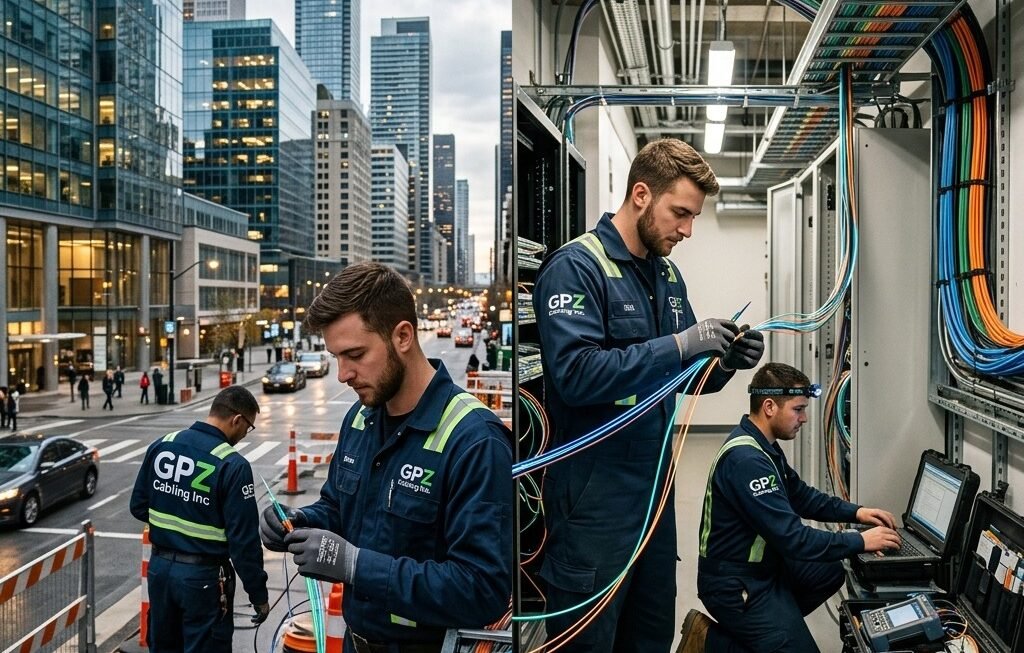
GPZ Cabling Inc. specializes in delivering fiber optic cabling services built for real-world performance. Whether you’re upgrading an aging infrastructure or building a new network from scratch, the difference fiber optic technology makes is immediate and measurable.
What Makes Fiber Optic Cabling So Effective?
At its core, fiber optic cabling transmits data as pulses of light through thin glass or plastic strands. This light-based transmission sets it apart from traditional copper wiring in nearly every meaningful way.
Copper cables carry electrical signals that are vulnerable to electromagnetic interference (EMI)—a real issue in environments with heavy machinery, elevators, or dense electronic equipment. Fiber optic cables are immune to EMI entirely. They don’t conduct electricity, which also makes them inherently safer and more reliable over time.
Speed and bandwidth are the other major advantages. Modern fiber optic systems can support data transmission speeds exceeding 100 Gbps, with capacity to scale even further as network demands grow. For businesses dealing with large file transfers, real-time video, cloud applications, or heavy VoIP traffic, that kind of bandwidth isn’t just impressive—it’s necessary.
How Fiber Optic Technology Supports High-Demand Environments
Not every environment puts the same pressure on a network, but for those that do, copper infrastructure often falls short fast.
Healthcare facilities, for instance, rely on rapid transmission of imaging files like MRIs and CT scans. Financial institutions process millions of transactions per second. Educational campuses stream video content to hundreds of simultaneous users. In all of these scenarios, fiber optic cabling handles the load with consistency that copper simply can’t match at scale.
Single-Mode vs. Multimode Fiber: Which One Fits Your Needs?
Two primary types of fiber optic cable serve different purposes, and choosing the right one matters.
Single-mode fiber uses a narrow core to carry light directly down the cable, enabling transmission over long distances—often several kilometers—without significant signal loss. It’s the preferred choice for connecting buildings, spanning campuses, or running data between facilities.
Multimode fiber uses a wider core that allows multiple light modes to travel simultaneously. It’s well-suited for shorter distances within a single building or floor, making it a practical and cost-effective option for local area networks (LANs) and data centers with closely grouped equipment.
GPZ Cabling Inc. evaluates each project individually, recommending the right fiber type based on your specific layout, distance requirements, and budget.
The Long-Term Value of Investing in Fiber Optic Infrastructure
One concern that sometimes slows businesses down is upfront cost. Fiber optic installation does require a greater initial investment compared to copper, but the long-term math almost always favors fiber.
Copper cables degrade. They corrode, attract interference, and eventually need replacement. Fiber optic cables, by contrast, are highly durable and resistant to environmental wear. They don’t rust, aren’t affected by temperature fluctuations the way copper can be, and can maintain signal integrity over decades when properly installed.
Maintenance costs drop significantly. Downtime becomes rarer. And because fiber optic infrastructure is designed with future bandwidth needs in mind, businesses avoid the cycle of repeatedly upgrading their cabling every few years as demands increase.
Why Fiber Optic Installation Quality Matters
Even the best cable performs poorly if it’s not installed correctly. Improper termination, poor cable routing, or inadequate testing can introduce signal loss, increase latency, and create maintenance headaches that compound over time.
Professional installation by certified technicians ensures every connection is clean, every run is properly documented, and every segment is tested against industry standards before it goes live. GPZ Cabling Inc. follows structured cabling standards and performs thorough post-installation testing to verify that the network performs exactly as specified.
Upgrading Your Network? Here’s What the Process Looks Like
Understanding what a fiber optic cabling project involves helps businesses plan with confidence. GPZ Cabling Inc. approaches every project through a clear, structured process:
- Site assessment: Evaluating your current infrastructure, space layout, distance requirements, and bandwidth needs.
- System design: Recommending the right fiber type, pathway routing, and hardware components tailored to your environment.
- Professional installation: Running cables with precision, terminating connections cleanly, and integrating with your existing network equipment.
- Testing and certification: Verifying every link meets performance standards using optical loss testing and other diagnostic tools.
- Documentation: Providing complete cable records and labeling so your team can manage the network confidently going forward.
Future-Proof Your Operations with GPZ Cabling Inc.
Technology moves fast. The applications businesses depend on today are far more bandwidth-intensive than they were five years ago, and the trend isn’t slowing down. Fiber Optic Cabling, as a purpose-built solution capable of delivering symmetrical gigabit speeds, near-zero latency, and virtually unlimited scalability — positions your organization to grow without hitting infrastructure ceilings every time your needs evolve.
GPZ Cabling Inc. brings the expertise, equipment, and commitment to quality that modern networks demand. From commercial office buildings to industrial facilities to multi-site enterprise environments, the team delivers fiber optic cabling solutions engineered for performance, reliability, and longevity.
When your network needs to perform at its best, there’s no smarter investment than fiber optic infrastructure—and no better partner to get it done right.
Ready to upgrade your network? Contact GPZ Cabling Inc. today to schedule a site assessment and discover what fiber optic cabling can do for your operations.