

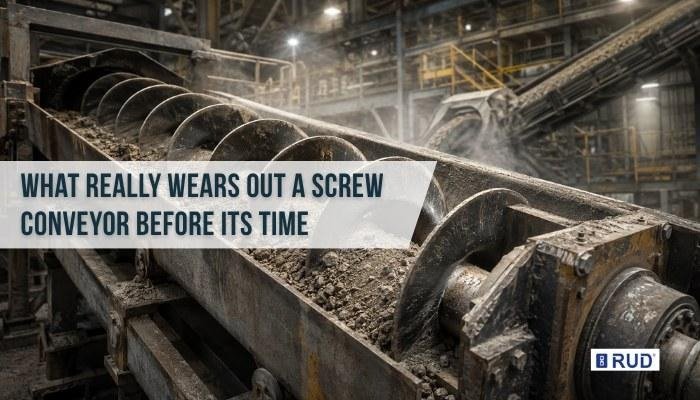
Screw conveyors are designed for durability. But in demanding industrial applications like mining, cement processing, and bulk materials handling, they don’t always reach their expected service life.
Unlike a conveyor belt, a screw conveyor uses rotating flights that stay in direct contact with the material being transferred. In abrasive applications, that constant contact can accelerate wear on important components.
We’re RUD Australia, and we’ve spent four decades supplying and servicing conveyor systems for Australian industry. We’ve tracked every common failure pattern back to a handful of preventable causes.
In this article, we’ll cover:
- The most common causes of premature screw conveyor wear
- Which components fail first and how to spot the damage
- Practical steps to extend your conveyor’s service life
Read on to learn more about what really wears out a screw conveyor and how to stop it.
Common Causes of Premature Screw Conveyor Wear
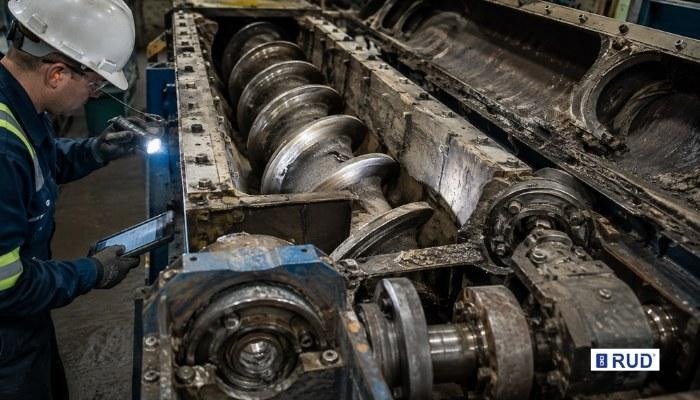
Screw conveyors wear out before their time due to a combination of material properties, loading errors, and incorrect mechanical settings. You can prevent most of these problems with regular maintenance, but they often go unnoticed until the damage is already done.
Here are the most common reasons a screw conveyor wears out ahead of schedule:
- Abrasive Bulk Materials: Hard rock, cement, and sand gradually wear down the flight edges with every rotation. At the same time, larger, coarser materials can cause deeper gouges in the flight surface and trough lining, which leads to faster wear over time.
- Trough Overloading: CEMA standards (Conveyor Equipment Manufacturers Association) recommend loading between 15% and 45%, depending on the material. Free-flowing bulk materials can handle the upper end, while abrasive or sluggish products shouldn’t exceed 15–30%.
- Misalignment Across the Trough Length: Misalignment should stay within 1/8 inch across the full conveyor length. If it exceeds that limit, the screw can experience repeated bending forces at each hanger bearing.
- Incorrect Screw Speed: Bearings and coupling shafts take the worst of it when RPM (Revolutions Per Minute) runs too high. Excessive speed can increase energy consumption and generate heat at hanger bearing contact points, and that heat buildup has led to fire on site.
- Material Buildup and Packing: Moist or sticky bulk materials can build up and harden inside the trough over time. As the buildup increases, it can push the screw upwards and put extra stress on the shaft, which may eventually cause fatigue fractures. Fly ash mixed with water is particularly prone to this problem.
- Undersized Discharge Openings: If a discharge chute is too small, it can restrict material flow out of the trough. In turn, backpressure builds, and the screw can become overpacked. This added load can cause the coupling bolts to snap.
Any one of these issues can shorten a screw conveyor’s service life. And when two or three of them overlap, the failure timeline accelerates even further.
Which Screw Conveyor Components Fail First?
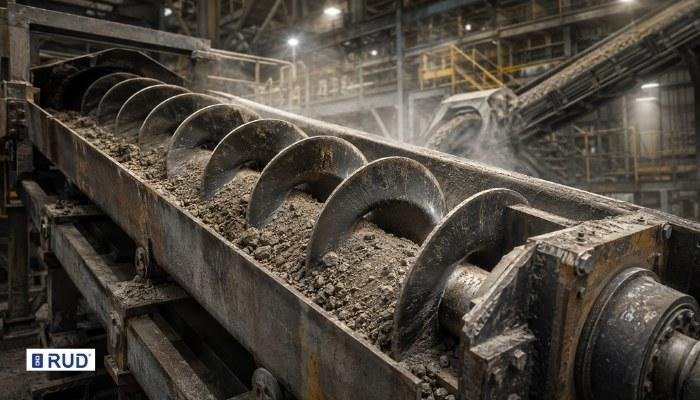
Flights, trough linings, and hanger bearings are the first components to show signs of wear in most screw conveyor systems. These components have the most contact with bulk materials and carry the highest mechanical loads.
If you know what to check for, you can detect wear early and reduce the risk of unplanned downtime.
Let’s take a closer look at the components that fail first.
Flights and Trough Lining
Constant contact with bulk materials gradually wears down the flight edges and reduces their outer diameter. One of the earliest signs of this wear is a shiny outer edge on the flight (it can look almost burnished).
Once the diameter shrinks, conveying capacity and conveyor efficiency drop, while the trough itself starts taking direct wear.
In horizontal screw conveyor systems, AR (Abrasion-resistant) steel trough liners help protect the trough from repeated impact and wear. It’s best to install them early rather than wait until significant damage occurs.
Hanger Bearings and Coupling Shafts
A single worn hanger bearing can shut down a full production line within hours. From our experience handling equipment, if wear exceeds 1/8 inch, you should replace the bearing immediately.
Prolonged misalignment can also cause fatigue fractures, which typically appear almost perpendicular to the shaft centreline.
Coupling shaft bolts are another weak point. Repeated stress loosens or snaps them, and that failure often happens without warning.
Seals and Drive Components
Worn seals let dust and material escape around the shaft ends. In processing environments like pet food or mineral handling, that spillage creates both safety hazards and contamination risks.
There’s one more sign of trouble: motor overload. It usually results from a jammed screw or an excessive feed rate at the inlet. When the drive fails, everything downstream stops with it, including connected transfer points.
Early Warning: Check the gearbox oil for metal particles during routine servicing. Fine metallic debris can reveal internal gear wear before noise, heat, or drive failure becomes noticeable.
How to Prevent Early Screw Conveyor Failure
To prevent early screw conveyor failure, focus on correct alignment, proper speed settings, wear-resistant materials, and proactive maintenance. These measures are relatively simple, but they can have a major impact on performance, durability, and operational efficiency.
The three practices below cover the majority of preventable screw conveyor failures:
- Scheduled Inspections: Quarterly checks are sufficient for standard, free-flowing materials. But abrasive bulk materials like cement or mineral ore need monthly inspections at a minimum. You should focus on flights, bearings, seals, and coupling shafts each time.
- Proper Alignment and Speed Settings: A string line provides a simple way to check trough alignment after installation or maintenance. You should also set the RPM to suit the material and conveyor diameter. If the speed or alignment is incorrect, the bearings can wear rapidly and fail much sooner than expected.
- Wear-Resistant Materials and Liners: AR steel trough liners help reduce abrasion in heavy-duty operations, while hardfaced flights and heavy-wall pipe improve durability. However, the right construction series depends on the type and classification of the bulk material.
RUD Australia manufactures BULKOS screw conveyors from Brisbane and Ipswich. They’re available as single, double, or triple units for horizontal and inclined transport, as well as vertical screw conveyor configurations.
What to Do Now to Extend Your Conveyor System’s Life
You can prevent most premature screw conveyor failures by addressing a few common issues. If you handle abrasive materials, avoid overloading and maintain proper alignment and speed settings. These measures can improve performance, reduce maintenance costs, and protect overall productivity.
During your regular inspections, check your flights, bearings and seals before minor wear leads to a full shutdown. You can also use AR steel liners and hardfaced flights from the outset.
We’ve been supplying conveyor systems and bulk materials handling equipment to Australian industry for over 40 years. Talk to our team about the right setup for your operation.