

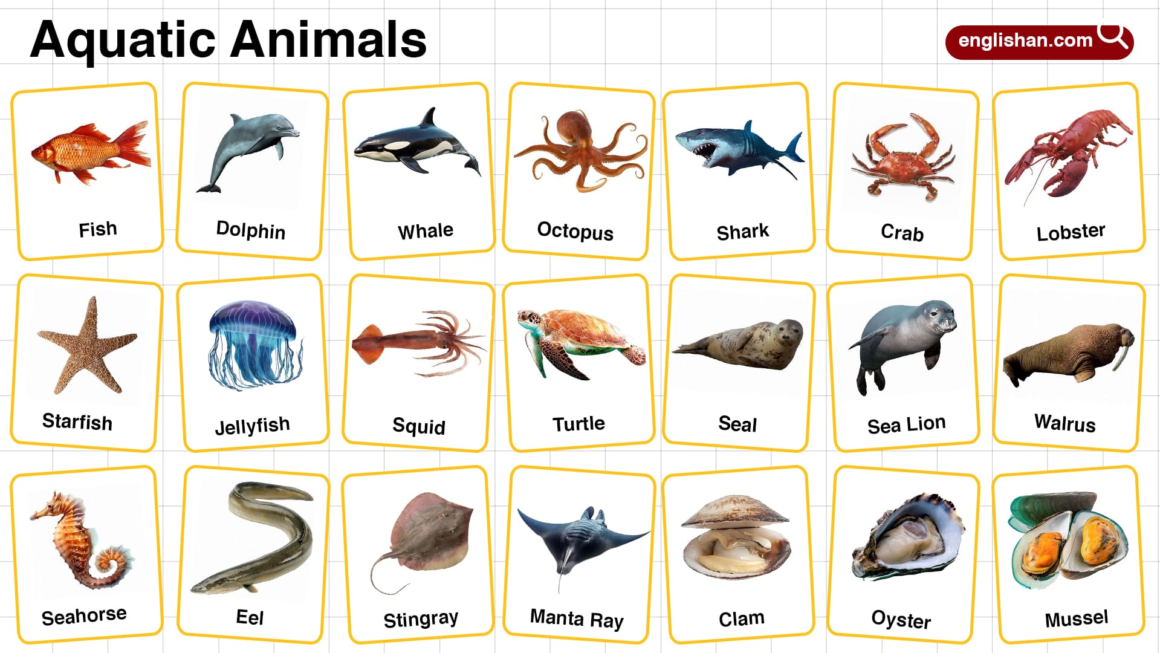
Aquatic animals are some of the most fascinating creatures on Earth. They live in oceans, seas, rivers, lakes, ponds, wetlands, and other water-based environments. From tiny fish moving through freshwater streams to enormous whales traveling across the open ocean, aquatic animals come in an incredible variety of shapes, sizes, colors, and behaviors. Learning about aquatic animals name is a useful way for students, parents, teachers, and anyone interested in nature to understand the amazing world beneath and around the water.
The term “aquatic animals” generally refers to animals that spend all or most of their lives in water. Some, such as fish, are highly adapted to living underwater, while others, such as dolphins and whales, must come to the surface to breathe air. There are also animals like frogs, crocodiles, turtles, and seals that divide their time between water and land.
In this article, we will explore a useful aquatic animals name list along with simple descriptions of each animal. The goal is not only to provide names but also to explain what makes these animals special and where they are commonly found. Whether you need names for schoolwork, general knowledge, or vocabulary practice, this guide provides an easy starting point.
What Are Aquatic Animals?
Aquatic animals are animals that live in or depend heavily on water for survival. Their habitats can include freshwater environments such as rivers, lakes, streams, and ponds, as well as saltwater environments such as oceans and seas. These animals have developed different adaptations that help them find food, move, reproduce, and survive in their particular environments.
Not every aquatic animal looks like a typical fish. Some have fins, gills, and streamlined bodies, while others have flippers, shells, tentacles, or powerful tails. Dolphins and whales are mammals, even though they spend their entire lives in water. Sea turtles are reptiles, while octopuses are mollusks. This variety makes aquatic life particularly interesting.
Aquatic animals also play important roles in ecosystems. They may act as predators, prey, scavengers, or consumers of plants and algae. Their activities can influence food chains, nutrient cycles, and the health of aquatic habitats. Protecting these animals therefore means protecting the environments that support many other forms of life.
20 Common Aquatic Animals Name List
There are thousands of aquatic species around the world, but some are especially familiar and useful to know. Here is a simple list of common aquatic animals: fish, whale, dolphin, shark, octopus, squid, jellyfish, seahorse, starfish, crab, lobster, shrimp, sea turtle, seal, walrus, penguin, crocodile, alligator, frog, and otter.
Each animal has its own unique characteristics. Fish generally breathe through gills and use fins for movement. Whales and dolphins are mammals and breathe air through blowholes. Sharks are fish with skeletons made primarily of cartilage rather than bone. Octopuses have eight arms and are known for their intelligence and ability to change color and texture.
Other animals on the list have equally interesting features. Sea turtles have protective shells and strong flippers for swimming long distances. Crabs have hard outer shells and claws, while jellyfish have soft bodies and tentacles. Otters are playful mammals that are excellent swimmers and can be found in both freshwater and coastal environments.
Fish
Fish are among the most familiar aquatic animals in the world. They can be found in nearly every type of aquatic habitat, from small mountain streams to deep ocean waters. Their bodies are generally adapted for swimming, and most fish use gills to take oxygen from water.
There are countless species of fish, ranging from tiny reef fish to huge species such as whale sharks. Some fish live close to the surface, while others survive in deep and dark parts of the ocean. Their diets also vary widely. Some eat plants and algae, while others feed on insects, smaller fish, or other aquatic organisms.
Fish are important to aquatic ecosystems because they occupy many different positions in food chains. They provide food for larger animals while also helping control populations of smaller organisms. Fish are also important to humans as a source of food, recreation, research, and economic activity.
Whales
Whales are among the largest animals ever known to have lived on Earth. They are marine mammals, meaning they breathe air, give birth to live young, and feed their babies with milk. Unlike fish, whales cannot breathe underwater and must regularly return to the surface.
Different whale species have different feeding methods. Some use baleen plates to filter tiny organisms such as krill and small fish from seawater. Others, such as sperm whales, have large teeth and can hunt larger prey. Whales can also travel enormous distances during seasonal migrations.
Whales are an important part of marine ecosystems. Their movements and feeding behavior influence the distribution of nutrients in the ocean. They are also a major subject of scientific research because their communication, migration patterns, social behavior, and adaptations reveal much about marine life.
Dolphins
Dolphins are intelligent marine mammals known for their streamlined bodies, social behavior, and remarkable swimming abilities. They breathe air through a blowhole located on top of their heads. This allows them to surface quickly while swimming.
Many dolphin species live in groups called pods. They communicate using clicks, whistles, and other sounds. Dolphins are also famous for echolocation, a system that helps them locate objects and prey by producing sounds and interpreting the returning echoes.
Dolphins eat a variety of marine animals, including fish and squid. Their intelligence and social nature have made them one of the most recognizable aquatic animals. However, like other marine species, dolphins depend on healthy oceans and can be affected by pollution, fishing activities, habitat changes, and other environmental pressures.
Sharks
Sharks are fascinating aquatic animals that have existed for hundreds of millions of years. They are fish, but their skeletons are primarily made of cartilage rather than hard bone. This lighter skeleton helps many sharks move efficiently through water.
There are many different kinds of sharks, and they vary greatly in size and behavior. Some species are relatively small, while whale sharks can grow to enormous sizes. Despite their reputation, sharks do not all hunt large animals. Whale sharks, for example, are filter feeders that consume tiny organisms.
Sharks play a crucial role in marine food webs. As predators, they can help maintain balance among populations of other marine animals. Protecting shark populations is important because changes in predator numbers can affect the wider health of ocean ecosystems.
Octopuses and Squids
Octopuses and squids belong to a group of animals called cephalopods. Octopuses have eight arms, while squids generally have eight arms and two longer tentacles. Both are highly adapted for life in the ocean.
Octopuses are particularly famous for their intelligence and problem-solving abilities. They can squeeze through surprisingly small spaces because they have soft bodies without rigid skeletons. Many species can also change their color and skin texture to communicate, hide from predators, or approach prey.
Squids are excellent swimmers and can move quickly by pushing water through their bodies. They are important prey for many larger marine animals, including some whales, fish, and seabirds. Both octopuses and squids demonstrate how dramatically different aquatic animals can be from land-based creatures.
Jellyfish
Jellyfish have soft, transparent or colorful bodies and long tentacles. They are found in oceans throughout the world and have existed for an extremely long time. Unlike fish, jellyfish do not have bones, brains, or hearts in the same form as vertebrate animals.
Their tentacles contain specialized cells that can deliver venom to prey or potential threats. Different species vary considerably in size and appearance. Some are tiny, while others can have long trailing tentacles.
Jellyfish are an important part of marine food webs. They feed on small organisms and can themselves become food for sea turtles, fish, and other predators. Large increases in jellyfish populations can sometimes occur when environmental conditions favor them, which makes them useful subjects for marine ecological research.
Sea Turtles
Sea turtles are reptiles that have adapted to spending most of their lives in the ocean. They have streamlined shells and powerful flippers that help them travel through water. Several species undertake long migrations between feeding areas and nesting beaches.
Sea turtles have different diets depending on their species. Some eat seagrasses and algae, while others consume jellyfish, sponges, crustaceans, or other marine organisms. Their feeding behavior can influence the health of marine habitats.
Unfortunately, sea turtles face several environmental challenges, including plastic pollution, accidental capture in fishing equipment, habitat loss, and disturbances at nesting beaches. Conservation programs around the world work to protect nesting sites and reduce threats to these remarkable reptiles.
Crabs, Lobsters, and Shrimp
Crabs, lobsters, and shrimp are crustaceans and are commonly found in marine and freshwater environments. They have hard outer coverings called exoskeletons that provide protection. Many species also have specialized legs or claws used for feeding, movement, defense, or capturing prey.
Crabs are especially diverse and can be found along beaches, coral reefs, muddy shores, rivers, and other habitats. Lobsters usually live on the seafloor, where they search for food among rocks and other structures. Shrimp range from tiny species to larger varieties and can occupy an impressive range of aquatic environments.
These crustaceans are important both ecologically and economically. They serve as food for many aquatic animals and are also widely harvested for human consumption. Their presence and abundance can provide useful information about the condition of aquatic ecosystems.
Seals and Walruses
Seals and walruses are marine mammals that spend much of their time in water. Their bodies are adapted for swimming, with flippers and layers of body fat that help them stay warm in cold environments.
Seals generally have streamlined bodies and are capable underwater hunters. They feed on fish, squid, crustaceans, and other marine organisms. Walruses are recognizable because of their large size, whiskers, and long tusks. They often use their tusks for activities such as hauling themselves onto ice or social interactions.
These animals depend on healthy marine ecosystems and, in some cases, stable sea-ice environments. Changes in climate, food availability, and habitat conditions can affect their populations and behavior. Studying seals and walruses helps scientists understand broader changes in marine environments.
Aquatic Animals in Freshwater Habitats
Not all aquatic animals live in the ocean. Freshwater habitats such as rivers, lakes, ponds, and streams are home to many fascinating species. Frogs, freshwater turtles, otters, crocodiles, alligators, freshwater fish, and numerous invertebrates can live in these environments.
Freshwater ecosystems are especially important because they support a huge amount of biodiversity despite covering a relatively small portion of Earth’s surface. The animals living there have adapted to differences in water temperature, flow, oxygen levels, vegetation, and food availability.
Freshwater animals also face serious challenges when their habitats become polluted or damaged. Plastic waste, chemical pollution, habitat destruction, invasive species, and changes in water availability can affect aquatic life. Keeping rivers, lakes, and wetlands healthy is therefore essential for both animals and people.
Why Aquatic Animals Are Important
Aquatic animals are essential components of food chains and ecosystems. Predators help regulate prey populations, while smaller organisms provide energy to animals higher in the food web. Even species that may seem insignificant can have important ecological functions.
Many aquatic animals also contribute to nutrient cycling. Their feeding, movement, waste, and decomposition can help nutrients move through aquatic environments. Whales, fish, crustaceans, and countless microscopic organisms all contribute in different ways to the productivity of water-based ecosystems.
Aquatic animals are also important to human life and culture. They support fisheries, tourism, research, education, and local economies. For many communities, rivers, lakes, and oceans are closely connected to food supplies and livelihoods. Protecting aquatic animals therefore has environmental, economic, and social value.
How We Can Protect Aquatic Animals
Protecting aquatic animals starts with protecting their habitats. Simple actions such as reducing plastic use, disposing of waste properly, conserving water, and avoiding unnecessary pollution can make a meaningful difference. Clean water is fundamental to the survival of aquatic species.
People can also support responsible fishing and conservation efforts. Choosing sustainably sourced seafood where reliable information is available can help reduce pressure on vulnerable populations. Supporting protected areas and reputable conservation organizations can also contribute to long-term wildlife protection.
Education is another powerful tool. When people understand aquatic animals and the challenges they face, they are more likely to make responsible choices. Even children can participate by learning about local rivers, ponds, beaches, and wetlands and developing habits that keep these environments clean.
Frequently Asked Questions About Aquatic Animals Name
What are aquatic animals?
Aquatic animals are animals that live in or depend significantly on water. They can be found in oceans, seas, rivers, lakes, ponds, streams, and wetlands. Examples include fish, whales, dolphins, sharks, octopuses, turtles, seals, crabs, and many others.
Which is the largest aquatic animal?
The blue whale is the largest known animal on Earth. It is a marine mammal and can reach an extraordinary size. Despite its enormous body, it primarily feeds on very small organisms, especially krill.
Are dolphins fish or mammals?
Dolphins are mammals, not fish. They breathe air using lungs, give birth to live young, and feed their babies milk. Their ability to live entirely in water is an excellent example of mammalian adaptation to marine environments.
What are some freshwater aquatic animals?
Examples of freshwater aquatic animals include many species of fish, frogs, freshwater turtles, otters, crocodiles, alligators, freshwater crabs, and numerous insects and other small organisms. The exact species found depend on the region and type of freshwater habitat.
Conclusion
Learning aquatic animals name is a simple way to begin exploring the enormous diversity of life associated with water. From colorful fish and intelligent dolphins to powerful sharks, graceful sea turtles, fascinating octopuses, and enormous whales, aquatic animals show just how varied life can be.
Every aquatic animal has a role within its ecosystem, whether it is a predator, prey species, scavenger, filter feeder, or plant eater. Understanding these roles helps us appreciate why healthy oceans, rivers, lakes, and wetlands matter so much.
The next time you see a fish in a pond, a bird near a river, or a documentary about life beneath the ocean surface, remember that aquatic animals are part of a much larger interconnected world. Learning their names is only the first step; understanding and protecting the habitats they depend on is what helps ensure these remarkable creatures continue to thrive.
You May Also Raed: Englishtistic