

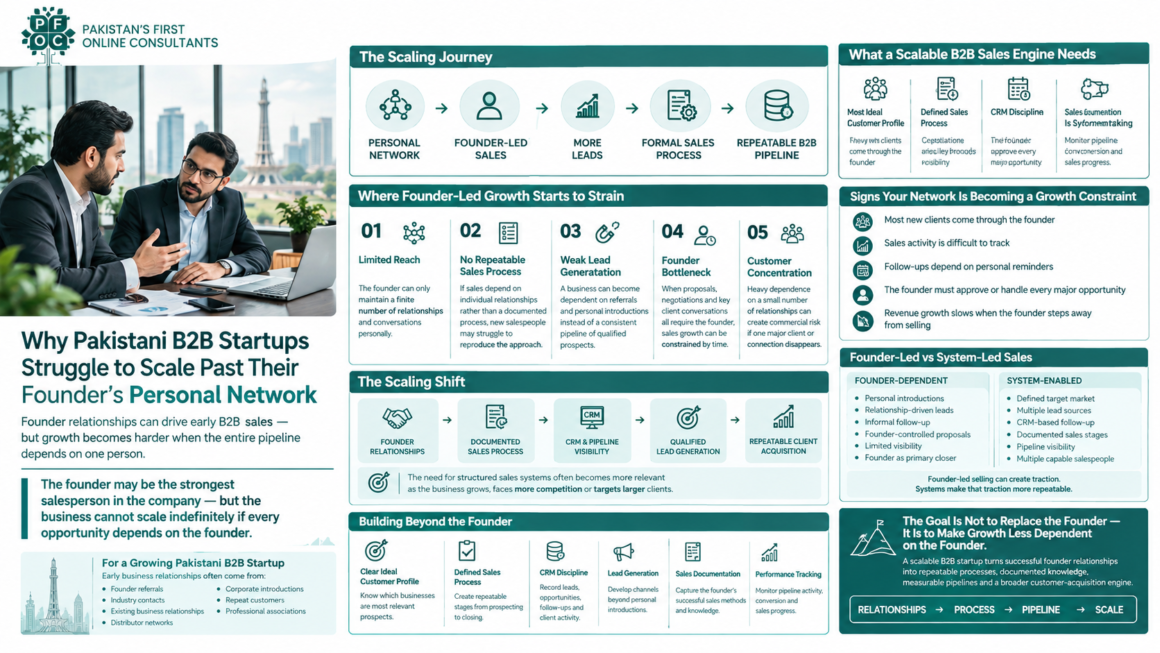
A founder in Lahore lands her first five clients through old university contacts and a former boss who took a chance on her. Deals close fast. Everyone’s happy. Then month eight hits. The network runs dry. Revenue stalls, even though the product hasn’t changed one bit. That’s usually when founders start looking into a business growth consultancy not because the product failed, but because the sales process was never really a system. It was one person’s relationships, running on manuals.
What Is Founder-Led Growth?
Pretty much what it sounds like. The founder’s credibility opens doors. It shortens the trust-building phase. It gets early customers to say yes faster than a stranger ever could. Picture a Lahore-based B2B software startup where the founder personally attends every meeting, explains the product, negotiates pricing, and handles onboarding too.
None of that’s a problem by itself. It becomes one the moment the business can’t sell, keep relationships warm, or decide anything without that one person in the room.
Why Does This Happen So Often in Pakistan?
Trust drives B2B buying here more than almost anything else. Warm introductions beat cold outreach, every time. Industry events matter more than most founders admit. People would just rather deal with someone they already know.
Then there’s visibility. Buyers often don’t even know the startup exists; the founder’s reputation outshines the company’s actual brand. Add the informal side: leads scattered across WhatsApp threads, follow-ups running on memory, no defined sales stages at all. Enterprise buyers eventually want references and documentation. A founder’s word alone won’t cut it forever.
Seven Signs Your Startup Depends Too Much on One Person
Worth checking honestly:
- Most new customers come through personal referrals, no other channel to fall back on.
- The founder attends every single sales meeting, no exceptions.
- The pipeline lives in someone’s head, not a system anyone else can see.
- Customers trust the founder more than the company itself.
- Monthly sales results swing wildly, no consistent process behind them.
- Every decision, big or small, needs founder sign-off first.
- Revenue leans on a handful of relationships, real concentration risk.
Sound familiar? Usually the issue isn’t the product. It’s that nothing’s been written down or measured yet.
The Hidden Pipeline Problems Behind This
Most startups here never actually defined an ideal customer profile industry, company size, decision-maker, real budget. Skip that step, and outreach turns into guesswork. There’s rarely a repeatable lead-generation process either, just whatever worked last time. Qualification stays vague. Follow-up slips. Nobody tracks basic numbers like conversion rate or sales cycle length. Hard to fix what you’ve never measured.
Building a Pipeline That Doesn’t Depend on One Person
Start with who you’re actually selling to industry, size, the real decision-maker, what makes them buy. Build a target list around that. Pick channels that match your buyer and sales cycle. LinkedIn, referrals, events, direct outreach. Not everything at once.
From there, build a simple way to separate a cold contact from a genuine opportunity. Put a CRM in place, or even just a well-structured spreadsheet, tracking deal value, stage, next steps. Build a basic playbook covering common objections, so a new hire isn’t reinventing the wheel every time. Review the pipeline weekly after that. Consistency beats intensity.
Building Trust in the Company, Not Just the Founder
Positioning matters more than founders expect. A proper website, consistent messaging, a value proposition that doesn’t rely on “trust me.” Case studies help too the customer’s problem, what got done, the result, with their permission to share it. Testimonials work the same way, as long as they stay honest instead of exaggerated.
Standardised onboarding, clear service expectations, a real escalation path. All of it signals the company can be relied on, not just the person who founded it.
Handing Off Sales Responsibility Without Losing Control
Document how the founder actually sells first. How prospects get identified, common objections, how pricing conversations play out. Bring team members in as observers next, before letting them run smaller meetings solo. Keep the founder involved only where it truly matters major accounts, pricing exceptions, real legal risk. The goal was never removing the founder completely. It’s stopping the founder being needed for every routine task.
The Financial Side of Founder-Dependent Growth
Customer concentration is the obvious risk. One client leaving shouldn’t threaten the whole business. Acquisition cost matters too. What does it actually take, in time and money, to land a customer, and does that stack up against what they’re worth long-term? Delayed B2B payments create real cash pressure, especially once hiring outpaces predictable revenue. Early discounting can quietly wreck margins if it becomes the habit instead of the exception.
When External Growth Support Actually Helps?
Makes sense when the founder can’t pin down the actual bottleneck, sales activity swings wildly, or the team needs real help building a CRM from nothing. A genuine business growth consultancy earns its cost here not by replacing the founder’s relationships, but by turning them into something the whole team can repeat.
Won’t fix everything, though. No consultant fixes a product that solves no real problem, unsustainable pricing, or a founder who refuses to document or delegate anything.
Consultant, Agency, or In-House Team?
| Option | Best for | Key question |
| In-house sales team | Long-term ownership | Can you afford hiring and managing it? |
| Lead-generation agency | Prospecting support | Do they actually understand your buyer? |
| Growth consultant | Strategy and systems | Is implementation included, or advice only? |
| Fractional sales leader | Experienced oversight | What authority do they actually have? |
None of these wins outright. It comes down to budget, stage, and how much you’d rather build versus borrow.
Frequently Asked Questions
Why do Pakistani B2B startups depend on the founder’s network?
Trust drives B2B buying here. Warm introductions close faster than cold outreach ever could.
Can a B2B startup grow without personal connections?
Yes with a documented pipeline and repeatable process. Takes real work to build, though.
When does founder-led sales become a bottleneck?
Once the business can’t generate leads, keep relationships warm, or decide anything without the founder involved.
Should I hire a consultant or build an internal team?
Comes down to budget and timeline. A consultant designs the system fast; an in-house team builds ownership over time.
How can I train employees to sell without the founder in the room?
Let them watch real meetings first. Then hand over smaller ones solo, keeping the founder for strategic deals only.
Conclusion
Personal networks are a fine way to land the first few customers. Terrible foundation for the next fifty, though. A repeatable pipeline, documented processes, trust that lives in the company rather than one inbox that’s what lets a founder actually step back without the business stalling. Start with whichever bottleneck feels most urgent, and fix that one first. PFOC (Pakistan’s First Online Consultants) is one place founders can start that conversation if they’d rather not figure it out alone.