

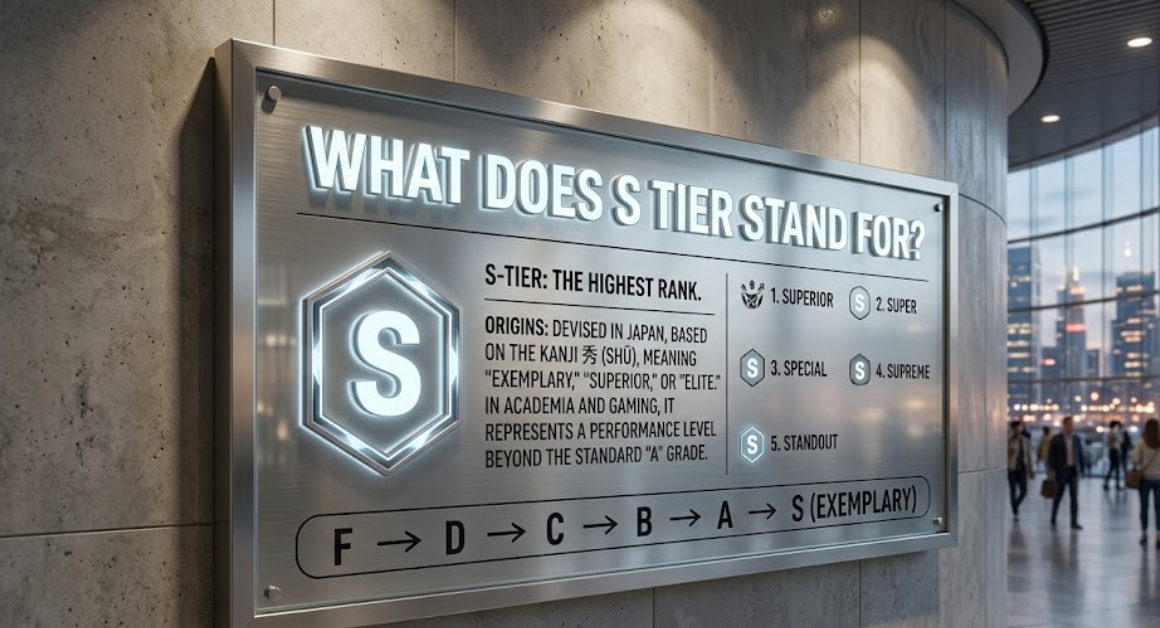
If you’ve ever seen something labeled S tier and wondered what it means, you’re not alone. The phrase what does S tier stand for often shows up in gaming, rankings, and online discussions—but its meaning isn’t always obvious at first glance.
Simply put, S tier represents the highest level of quality or performance in a ranking system. In this guide, we’ll break down where the term comes from, how it’s used, and why it’s become so popular across gaming, pop culture, and internet communities.
What Does S Tier Stand For?
The term S tier comes from ranking systems used in video games and competitive communities, especially in Japan.
In most tier lists, rankings go like this:
- S Tier = Super / Superior (top level)
- A Tier = Excellent
- B Tier = Good
- C Tier = Average
- D Tier = Below average
So when people ask what does S tier mean, the answer is simple: it represents the absolute best category—above even A tier.
What Is S Tier in Gaming?
One of the most common places you’ll see S tier is in gaming.
Character Rankings
Games often rank characters based on strength or usefulness:
- S tier characters = strongest, most versatile
- A tier = strong but slightly less optimal
- Lower tiers = situational or weaker picks
Weapon or Item Tier Lists
Weapons or gear may also be ranked:
- S tier weapons = highest damage, best stats, or easiest to use
- Lower tiers = less effective or niche use cases
In competitive gaming, choosing S tier options can sometimes give players a clear advantage.
What Is S Tier in Pop Culture and Internet Use?
Outside of gaming, S tier meaning has expanded into everyday internet language.
People use it to describe:
- Food (“That burger is S tier”)
- Movies or shows (“This series is S tier entertainment”)
- Athletes or performers
- Products or brands
It’s basically a shortcut for saying: this is the best of the best.
Why Is It Called “S Tier”?
Interestingly, the “S” doesn’t officially stand for one fixed word in English. However, common interpretations include:
- Superior
- Special
- Supreme
- Super
The term likely originated from Japanese grading systems where “S” was used above “A” to indicate exceptional quality.
Over time, Western gaming communities adopted it, and it became a global internet standard.
S Tier vs A Tier: What’s the Difference?
Understanding the difference helps clarify rankings:
S Tier
- Best possible category
- Extremely high performance
- Rare or exceptional quality
A Tier
- Very strong and reliable
- Slightly below perfect
- Still highly recommended
In simple terms: S tier is “elite,” while A tier is “excellent but not perfect.”
Why S Tier Rankings Are So Popular
The S tier system is widely used because it is:
- Easy to understand
- Visually simple
- Flexible across topics
- Fun for comparisons
It removes complex scoring and replaces it with clear, intuitive categories.
Common Misconceptions About S Tier
Many people assume:
- It means “perfect” in a mathematical sense (it doesn’t)
- It is officially standardized (it varies by list creator)
- It always means unbeatable (context matters)
In reality, S tier is subjective and depends on whoever is making the ranking.
FAQs
What does S tier stand for?
It generally stands for “superior” or “special” and represents the highest ranking in a tier list.
What is S tier in simple terms?
It means something is the best or top-performing in its category.
Is S tier higher than A tier?
Yes, S tier is above A tier and represents elite-level quality.
Where is S tier used most?
It is commonly used in gaming, memes, reviews, and online ranking lists.
Is S tier official?
No, it is a community-based ranking system, not an official grading standard.
Conclusion
So, when you see what does S tier stand for, the answer is simple: it represents the highest level of quality or performance in a ranking system. Whether it’s used in gaming, pop culture, or online reviews, S tier has become a universal way to say “this is the best.”
Understanding tier lists makes online discussions easier to follow—and once you get the system, you’ll start spotting S tier labels everywhere.