
Spills happen. That’s not pessimism—it’s physics. Tanks leak, hoses fail, and even the most experienced crews deal with unplanned releases. The real question isn’t whether a spill will occur; it’s whether your site is ready when it does.
Secondary containment is the layer of protection that stands between a minor incident and a full-scale environmental disaster. For energy companies, industrial operators, and project managers handling hazardous materials, having the right containment system in place isn’t just smart practice—it’s a regulatory requirement and a professional responsibility.
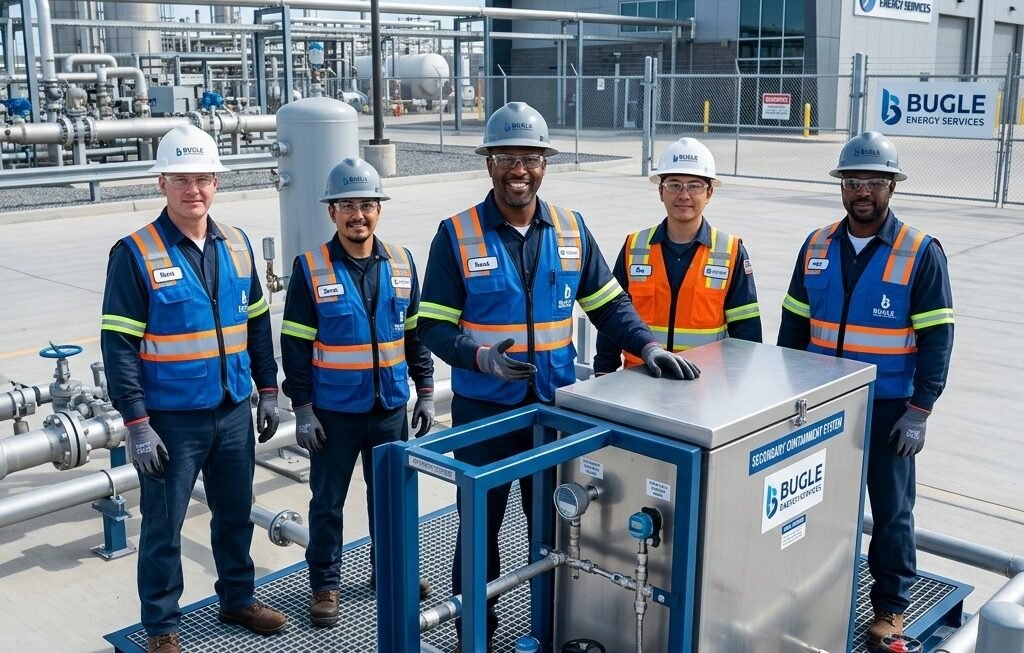
Bugle Energy Services has built its reputation on delivering containment solutions that perform when the pressure is on. Here’s a closer look at why secondary containment matters and what sets a high-quality service apart.
The Real Cost of a Containment Failure
A single uncontained spill can cascade quickly. Contaminated soil, polluted groundwater, regulatory fines, and operational shutdowns are all on the table. According to the U.S. Environmental Protection Agency (EPA), improper containment of hazardous substances is among the leading causes of environmental violations at industrial sites.
Beyond the environmental damage, the financial exposure is significant. Cleanup costs alone can run into the tens of thousands of dollars, and that’s before factoring in potential legal liability, project delays, and reputational damage with clients and regulators.
Secondary containment removes that risk from the equation—or at minimum, dramatically reduces it.
What Secondary Containment Actually Does
At its core, secondary containment is a backup barrier system designed to capture and hold any material that escapes its primary container—whether that’s a storage tank, a drum, a tote, or a pipeline connection.
These systems come in various forms depending on site conditions and the materials being handled:
- Berms and containment berms — Flexible, portable barriers that create a contained area around equipment or storage vessels.
- Spill decks and drip trays — Positioned beneath tanks or transfer points to catch small-volume leaks before they spread.
- Liner systems — Used in pit or basin applications to prevent ground absorption.
- Secondary containment tanks — Double-wall tanks that provide built-in containment without requiring additional infrastructure.
Each solution serves a specific purpose. The key is matching the right system to the site’s operational profile—something that takes real-world field experience to get right.
How Bugle Energy Services Approaches Secondary Containment
Bugle Energy Services approaches containment not as a checkbox, but as a critical component of site safety planning. The team works directly with clients to assess risk exposure, regulatory requirements, and the physical demands of the job site.
That means recommending solutions that are practical for field conditions—not just compliant on paper. A containment berm that performs in a controlled warehouse setting may be the wrong call on a remote oilfield site exposed to extreme temperature swings and heavy equipment traffic.
Secondary containment provided by experienced professionals—who assess your actual operational risks, recommend fit-for-purpose systems, and ensure proper installation and maintenance—is the kind of proactive protection that keeps your project on schedule and your compliance record clean.
Bugle Energy Services brings that level of technical expertise to every engagement, whether it’s a short-term project requiring portable containment or a long-term facility solution that demands engineered systems and regular inspection.
Why Compliance Alone Isn’t the Right Goal
Most operators know they’re required to have secondary containment systems under regulations like EPA’s Spill Prevention, Control, and Countermeasure (SPCC) rule or OSHA’s Hazardous Waste Operations standards. But treating compliance as the finish line tends to produce systems that barely meet the minimum—and fail precisely when they’re needed most.
The better standard is functional reliability. A containment system should be:
- Properly sized to hold 110% of the largest container’s volume, as required under most SPCC guidelines.
- Compatible with the stored material, since certain chemicals degrade common liner materials over time.
- Accessible for inspection, so any degradation or damage is caught early.
- Maintained on a schedule, not just installed and forgotten.
Bugle Energy Services builds this kind of thinking into every project. Clients don’t just get equipment—they get a containment strategy that accounts for how the site actually operates day to day.
The Industries That Benefit Most
Secondary containment is relevant across a wide range of sectors, but it’s especially critical in:
- Oil and gas — Where bulk fluid storage and high-pressure transfer lines create significant spill exposure.
- Chemical manufacturing and processing — Where material compatibility and volume requirements demand engineered solutions.
- Construction and infrastructure — Where temporary fuel and lubricant storage on job sites requires portable, deployable containment.
- Power generation — Where transformer oil and fuel storage are common liability points.
Bugle Energy Services works across these industries, adapting containment solutions to the specific risks and regulatory requirements each one presents.
Protecting Sites, Protecting the Future
Environmental stewardship and operational efficiency are not competing priorities. The right secondary containment system protects your site from liability, keeps your crew working without interruption, and demonstrates the kind of professional diligence that clients and regulators notice.
Bugle Energy Services is committed to delivering containment solutions that do exactly that—reliable, field-tested, and built around your operation’s real needs. Whether you’re planning a new project or reassessing your current setup, now is the right time to get containment right.
Contact Bugle Energy Services today to learn more about secondary containment solutions tailored to your site.