

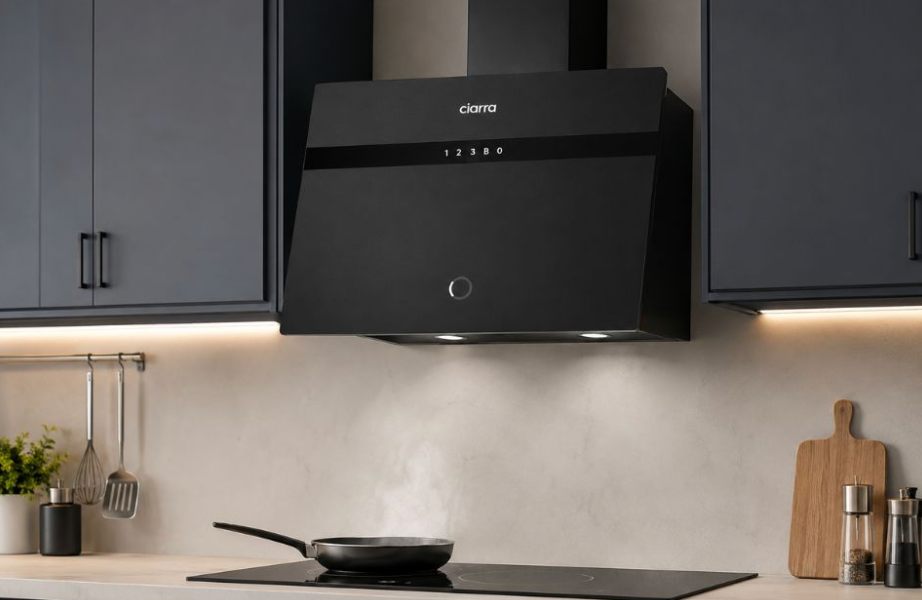
Many homeowners spend considerable time comparing a cooker hood’s extraction rate, noise level, appearance, and features, but pay far less attention to what happens behind the hood. The ducting is often treated as a simple connection rather than an important part of the ventilation system. That can be a mistake.
A cooker hood can only move extracted air as effectively as the complete system allows. The duct diameter, route, number of bends, connections, and external outlet can all influence how easily air travels away from the kitchen. A poorly planned route may create unnecessary resistance, while an appropriately designed system can provide a more practical path for extracted air.
Understanding cooker hood ducting before installation can therefore help homeowners make better decisions, avoid common installation problems, and set more realistic expectations about extraction performance.
What Does Cooker Hood Ducting Actually Do?
Cooker hood ducting is the pathway that carries extracted air from the hood toward an external outlet. In a ducted installation, air containing cooking odours, moisture, grease particles, and other airborne by-products is drawn into the hood and then directed through the duct before being discharged outside.
This means the duct is not simply an accessory attached to the appliance. It is part of the overall extraction route. If that route is unnecessarily restrictive, the ventilation system may have to work against greater resistance than expected.
The alternative is a recirculating setup, where air passes through filters and is returned to the kitchen instead of being exhausted outdoors. These systems can be useful where external ducting is impractical, but they operate differently from externally ducted extraction. Understanding which arrangement is being installed is therefore important before planning the kitchen layout.
Why Cooker Hood Ducting Affects Extraction Performance
A cooker hood is only one part of an extraction system. Its performance depends not only on the appliance itself but also on the path through which air has to travel. A useful way to think about the system is as a chain: the hood captures air, the duct provides the route, and the external outlet provides the final exit point.
If the duct route is long, restricted, or contains several unnecessary bends, the air has to move through a more challenging pathway. This can increase resistance and may affect the amount of air the system is able to move in practice. That does not mean every long duct installation will perform poorly, but it does mean that the installation should be planned rather than improvised.
The manufacturer’s installation instructions are particularly important because different cooker hoods can have different requirements. Instead of judging performance from the appliance specification alone, homeowners should consider how that specification relates to the actual ducting arrangement in their kitchen.
How Poor Ducting Can Reduce Airflow
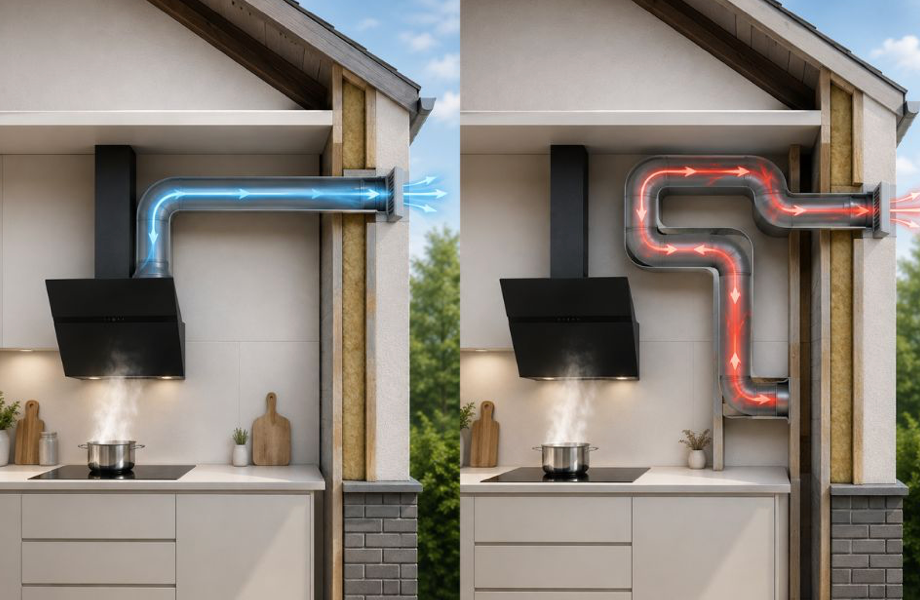
One of the most common mistakes is assuming that any ducting arrangement will work equally well. In reality, the route taken by extracted air matters. A duct that is excessively long, unnecessarily narrow, or filled with sharp turns can create additional resistance compared with a more direct route.
Connections can also matter. Poorly fitted joints may allow air to escape from the intended pathway, while crushed or restricted ducting can reduce the usable passage available for airflow. The external termination deserves attention too, because the final outlet should provide a suitable exit rather than creating another unnecessary restriction.
Common factors that can make a ducting route more challenging include:
● Excessively long duct runs
● Unnecessary or sharp bends
● Incorrectly reduced duct diameter
● Crushed or restricted ductwork
● Poorly secured connections
● Leaks around joints
● An unsuitable or poorly planned external outlet
These issues do not necessarily mean an extraction system will stop working. Rather, they can make the system less efficient than it could be. The goal should therefore be to create a practical, appropriately sized route that follows the appliance manufacturer’s requirements.
Why Duct Diameter, Length and Bends Matter
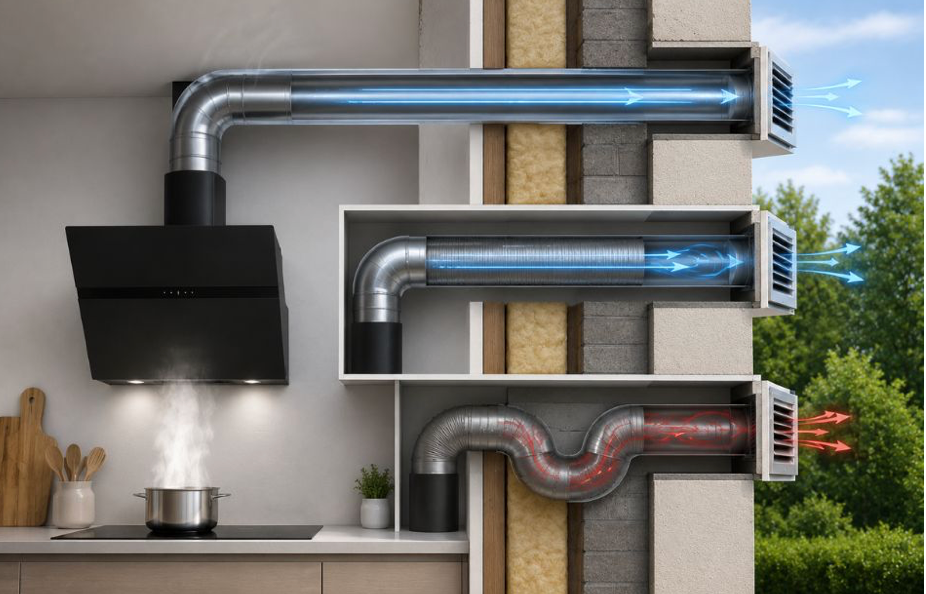
Duct diameter is one of the details that should be checked before installation. A homeowner may be tempted to use a smaller duct because it fits more easily into a particular space, but reducing the recommended diameter can increase resistance to airflow. The correct size should therefore come from the hood manufacturer’s installation requirements rather than from convenience alone.
Duct length is another consideration. A short, reasonably direct route generally gives air fewer obstacles to overcome than a much longer route. However, the layout of the property often determines what is practical. The objective is not necessarily to create the shortest route at any cost, but to avoid unnecessary length and restrictions where possible.
Bends also influence the route. Every change in direction alters the path through which air travels. A few unavoidable bends may be perfectly reasonable, but adding several sharp turns simply because the route was not planned can make the system more restrictive. In simple terms, moving air through a narrow, winding pathway is generally more demanding than moving it through a suitable, more direct one.
Ducted vs Recirculating Cooker Hoods: What’s the Difference?
Ducted and recirculating cooker hoods solve the ventilation problem in different ways. A ducted system sends extracted air through a duct and ultimately outside the building. A recirculating system instead passes air through filters before returning it to the kitchen.
External ducting can provide a direct route for extracted kitchen air to leave the building, but it requires a suitable installation route and an appropriate external outlet. This can be straightforward in some homes but more complicated where the cooker is positioned far from an exterior wall or where structural changes would be required.
Recirculating systems can be useful where external ducting is not practical. They avoid the need for an external exhaust route, but their operation depends on appropriate filters and regular maintenance. They also do not remove room air outdoors in the same way as a ducted system.
Neither approach should automatically be described as the right choice for every kitchen. The decision depends on the property, available installation options, ventilation requirements, appliance specifications, and the homeowner’s priorities.
Common Cooker Hood Ducting Mistakes Homeowners Make
Many ducting problems happen because installation details are considered after the kitchen layout has already been finalized. By that stage, the easiest route may no longer be available, encouraging compromises that could have been avoided with earlier planning.
Some common mistakes include:
● Reducing the recommended duct diameter to fit a smaller space
● Creating an unnecessarily long route
● Using too many sharp bends
● Allowing flexible ducting to become restricted or poorly supported
● Leaving connections inadequately secured
● Overlooking the design of the external outlet
● Failing to consider how the ducting will be accessed for future maintenance
Another mistake is assuming that general advice about one cooker hood automatically applies to every other model. Installation requirements can vary, so the manufacturer’s instructions should always be treated as the starting point.
Good planning before installation is usually easier than correcting a difficult duct route after cabinets, walls, ceilings, or other kitchen components have already been installed.
How to Plan Cooker Hood Ducting Before Installation
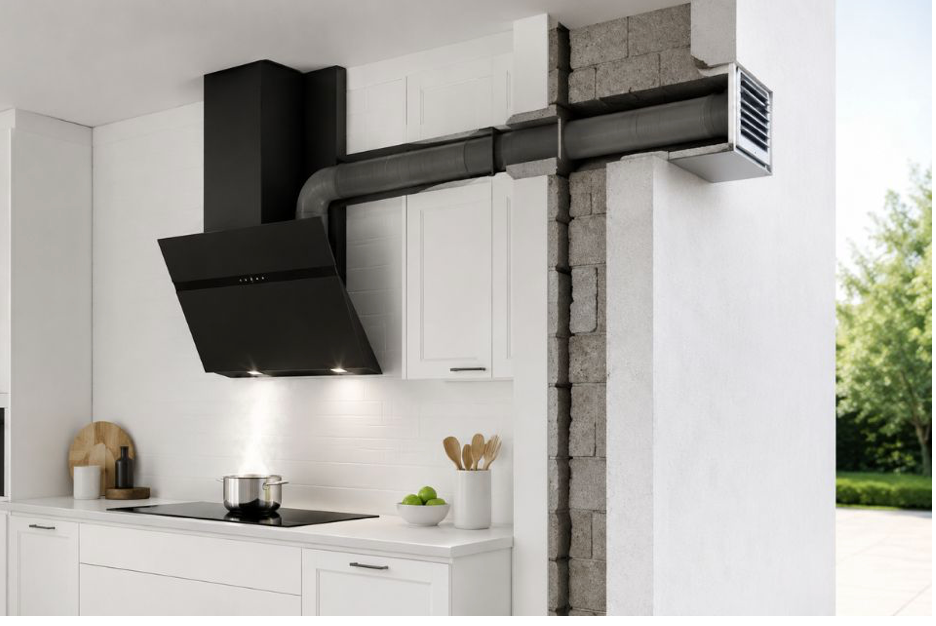
The best time to think about ducting is before the kitchen layout is fixed. Start by checking the installation instructions for the specific hood, including the recommended duct diameter and any requirements relating to the exhaust route. This provides a more reliable starting point than choosing a duct based purely on what is easiest to install.
Next, consider the route from the hood to the external outlet. Where practical, aim for a sensible and reasonably direct pathway while minimizing unnecessary bends. The location of the external termination should also be considered because it forms the final part of the ventilation route.
When selecting a specific model such as Ciarra ONE, homeowners should review its installation requirements before deciding where the duct will run. Planning the appliance and ventilation route together can help avoid situations where the preferred hood position creates an unnecessarily complicated exhaust path.
Before installation begins, it is also worth considering access for inspection and maintenance. Depending on the property and installation, local building or ventilation requirements may also apply. Where the installation involves significant structural work or an unusually complicated route, professional advice can help identify potential problems before work begins.
When Should You Consider Professional Installation?
Not every cooker hood installation requires the same level of expertise. A straightforward setup with an accessible external wall may be relatively simple, while a long or complicated duct route can introduce several additional considerations.
Professional assistance can be particularly useful when the installation involves structural changes, multiple bends, difficult external termination points, ceiling or wall modifications, or an apartment with shared ventilation arrangements. In these situations, the practical route may not always be obvious from the kitchen itself.
A professional can also help identify whether the proposed route is compatible with the appliance requirements and applicable building or ventilation rules. This does not mean homeowners need professional assistance for every installation. It simply recognizes that more complicated ventilation routes can benefit from being assessed before the work begins.
The Bigger Picture: A Cooker Hood Is Only One Part of the Ventilation System
It is easy to compare cooker hoods by looking at specifications displayed on a product page, but those figures do not exist independently of the installation. Real-world extraction involves the appliance, the ducting, the route, the connections, and the external termination working together.
This is why two kitchens using similar appliances can have very different installation requirements. One may allow a relatively direct route to an outside wall, while another may require a longer path with several changes in direction. The physical characteristics of the building can therefore influence what is practical.
Homeowners should also remember that ventilation is not a one-time consideration. Filters, accessible components, duct connections, and other parts of the system may require inspection or maintenance over time. Looking at the complete system from the beginning makes it easier to understand both its capabilities and its limitations.
Final Takeaway
Cooker hood ducting deserves more attention than it often receives because the hood is only one component of the extraction system. The duct provides the route that extracted air must follow, and its diameter, length, bends, connections, and external termination can all influence how easily air moves through the system.
The most sensible approach is to plan the ventilation route before installation, follow the specific manufacturer’s requirements, and avoid unnecessary restrictions wherever practical. Homeowners should also recognize that ducted and recirculating systems work differently, so the best option depends on the property and installation circumstances.
For those comparing kitchen extraction solutions, Ciarra Appliances can be another source to explore while considering the specific requirements of the appliance, kitchen layout, and ventilation installation.
FAQ
1. Why is cooker hood ducting important?
Cooker hood ducting provides the route for extracted air to leave the kitchen. The duct’s size, length, bends, and connections can affect airflow resistance and the overall effectiveness of the extraction system.
2. Does the length of cooker hood ducting affect performance?
Yes. A longer duct route can create more resistance, particularly when it includes several bends or restrictions. Where practical, a reasonably direct route can help the system move air more effectively.
3. Do bends in cooker hood ducting reduce airflow?
Bends can increase resistance within the ducting, especially when they are sharp or unnecessary. A well-planned route should minimize avoidable bends while still working with the layout and installation requirements of the kitchen.
4. What happens if cooker hood ducting is too small?
Using ducting smaller than the recommended size can increase resistance and may affect extraction performance. The correct diameter can vary between models, so homeowners should always check the manufacturer’s installation instructions.
5. Is ducted extraction better than a recirculating cooker hood?
Not necessarily for every kitchen. Ducted systems send extracted air outdoors, while recirculating models filter air and return it to the room. The better option depends on the property, available ventilation route, installation requirements, and homeowner needs.