

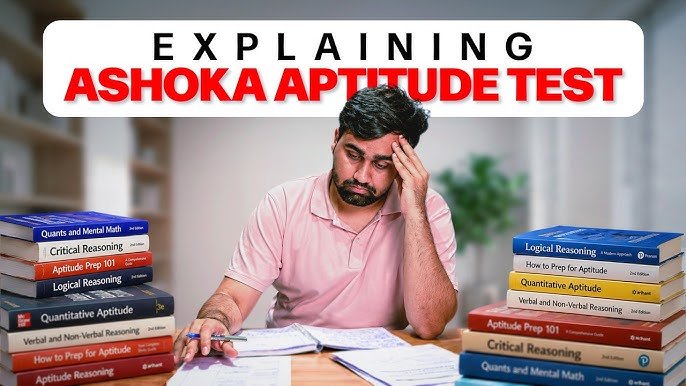
The selection criteria of top-notch universities have transcended mere academic performance. Today, there is an increased need for candidates with good analytical skills, logical reasoning, problem-solving, and decision-making. Ashoka Aptitude Assessment (AAA) tests a student’s skills in these areas and gives a more comprehensive view of a candidate’s aptitude. Although the test may seem intimidating at first, there is actually a very straightforward approach to preparing for it, which will make preparation easy for students. Rather than preparing through revision alone, it is necessary for students to work on developing their aptitude test preparation skills.
Why Preparing for the Ashoka Aptitude Assessment Matters
This really isn’t like a history or biology test where you cram a bunch of facts, dump them onto the paper, and forget them by dinner time. It’s checking how quickly and accurately you digest information you’ve probably never seen before, all while a clock ticks away. Since cramming facts won’t save you here, your daily prep has to focus on training your logic, getting your accuracy down, and finding a rhythm that doesn’t leave you gasping for air. Getting used to how these questions try to trick you beforehand is what takes the sheer terror out of test morning.
Tips to Improve Your Score in the Ashoka Aptitude Assessment
1. Understand the Test Format
Before you start throwing yourself at stacks of random practice sheets, just sit down and look at how the exam is actually put together. Check out the main question types, figure out how they score things, look at where the hard sections usually sit, and see how many minutes you get per section.
When you know what you’re walking into, your brain stays a lot calmer. Students who spend an hour mapping out the exam structure early on end up making way fewer silly mistakes later, mostly because nothing on the page catches them completely off guard.
2. Build Strong Logical Reasoning Skills
A significant portion of the Ashoka aptitude assessment involves applying logical reasoning. You are expected to come across a weird mixture of visual patterns, number problems, analysis problems, and comprehension passages.
As opposed to simply memorizing shortcuts that might work for you sometimes but do not always, try to figure out the reasons behind their being correct. Just give a few hours of your time every day to solving a few logical reasoning problems, and soon enough you’ll see how quickly you can solve them.
3. Strengthen Quantitative Aptitude
Like it or not, basic math is going to show up. You’ll definitely see stuff like percentages, ratios, quick averages, work-and-time problems, and basic probability.
Make sure your regular aptitude test preparation includes a tiny bit of math every day. You don’t need to do three-hour sessions; even solving five or six quant problems over breakfast keeps your head quick with numbers so you don’t stall during the exam.
4. Improve Reading and Verbal Skills
Whereas most of the candidates give considerable importance to Mathematics. But the other sections, which comprise the test, for instance, Verbal Reasoning and Reading Comprehension, are generally neglected.
Reading newspapers, editorials, magazines, and good articles on the net enhances your vocabulary as well as the ability to comprehend analytically. Even though it may not necessarily be fun every day, there is an obvious improvement within a period of several weeks.
5. Prepare for the On-the-Spot Essay
While the Ashoka Aptitude Test primarily deals with analyzing skills, it is equally important to give attention to the other main element of the admissions test, which is the On-the-Spot Essay. Knowing how to organize your thoughts in a short span of time is essential because the essay is written in a short span of time.
Develop the skill of writing short essays on present issues or abstract topics in 30 minutes. The key to the essay lies in the clear introduction, logical arguments, and a clear conclusion.
6. Practice Under Timed Conditions
Solving a logic puzzle while lying on your bed with zero stress is easy. Solving that exact same puzzle while a timer is aggressively counting down in the corner of your screen is a whole different game.
Stop doing all your practice casually. Slap a timer on your desk every single time you sit down to work. It forces you to learn pace control and keeps you from wasting five precious minutes obsessing over one single stubborn question on test day.
7. Solve Mock Tests Regularly
Mock exams prove to be one of the most useful ways to prepare for any kind of exam. These tests replicate the actual test environment and assist students in getting acquainted with the test atmosphere.
Performing full mock tests also reveals those areas where the candidate lacks proficiency. Analyze all tests thoroughly rather than just looking at the scores. At times, the errors reveal more about the candidates than the answers themselves.
8. Analyze Your Mistakes
Churning through five hundred practice questions is a total waste of time if you keep repeating the exact same errors every round.
Keep a cheap notebook on your desk, write down every question you miss, and jot down why you got thrown off. Go back and look at that notebook every few days. Figuring out your own bad habits builds real test instincts way faster than blindly grinding new worksheets. Making this a routine is what real aptitude test training looks like.
9. Focus on Accuracy Before Speed
The tendency among most students is to try to be fast in answering the questions right from the outset. This usually results in unnecessary errors.
Accuracy should come before increasing your speed. With better comprehension, the speed will automatically come without compromising accuracy.
Let’s Sum Up!
A successful preparation strategy for the Ashoka Aptitude Assessment goes beyond memorizing formulas or solving random aptitude questions. Development of logical reasoning ability, quantitative aptitude, verbal skills, error analysis, practice tests, and timed test practice are some activities that would lead to good results. As part of the admission process at Ashoka University, an on-the-spot essay may also be required; hence, it is important for candidates to spend time developing their analytical writing skills.
For those seeking professional assistance in Ashoka aptitude test preparation, Jamboree India provides aptitude test training programs, skilled mentors, study material, and assistance in undergraduate entrance test preparation.