

For millions of students, the Edexcel International General Certificate of Secondary Education (IGCSE) is one of the most significant academic milestones of their secondary years.
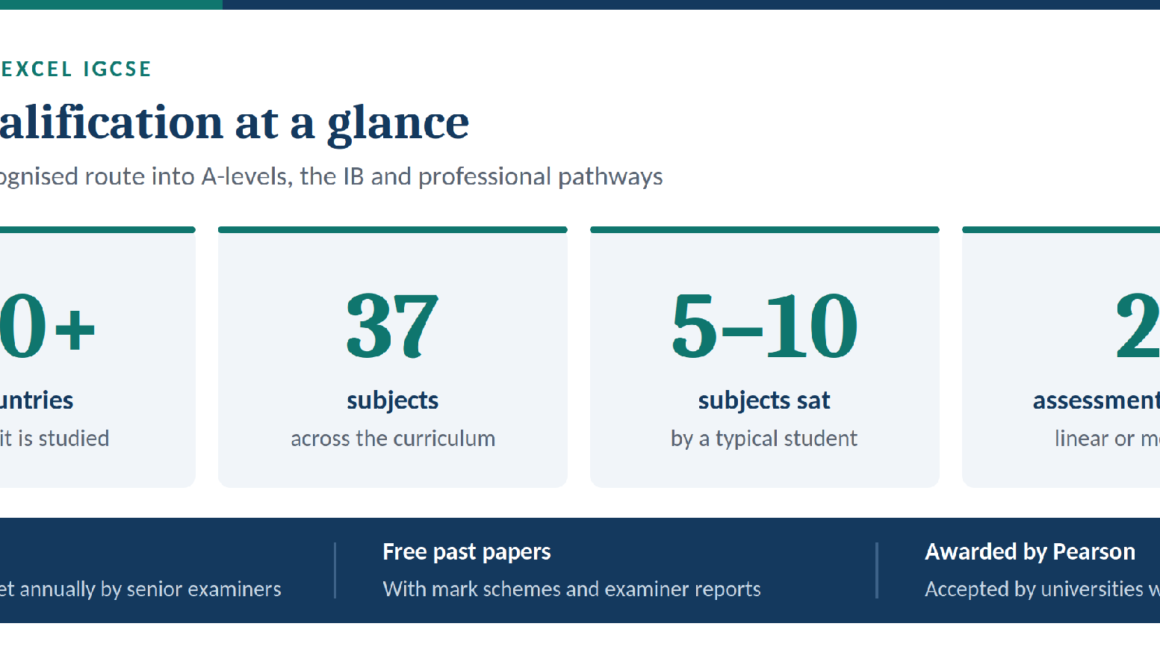
Studied in more than 80 countries across 37 subjects, the Pearson Edexcel IGCSE is accepted by universities globally and lays the foundation for A-levels, the International Baccalaureate, and professional entry pathways.
Yet many students approach these examinations with a mixture of ambition and anxiety, uncertain whether their current preparation will hold up when it matters most.
Who this guide is for
Students and parents who want more than generic revision tips — whether you are building a study schedule from scratch, targeting gaps in specific subjects, or spreading effort across a demanding subject load.
The goal is straightforward: enter your IGCSE exams genuinely prepared, with a clear sense of how to perform — not just how to revise.
Understanding the Edexcel IGCSE: Structure, Subjects, and Stakes
The Edexcel IGCSE is developed and awarded by Pearson, one of the world’s largest education companies. It spans Mathematics, Sciences, Languages, Humanities, Arts, and Business Studies.
| 80+countries where it is studied | 37subjects across the curriculum | 5–10subjects sat by a typical student |
What sets Pearson Edexcel apart
- Precisely structured syllabuses — every requirement is spelled out at specification level.
- A modular assessment option — available alongside the standard linear route.
- A large bank of free past papers — several years’ worth, for every subject.
Assessment comes through written examinations, coursework components, or a combination of both, depending on the individual subject specification.
Grade boundaries are set annually by senior examiners and reflect the full cohort’s performance — so efficient mark-targeting matters as much as broad content coverage.
It is not simply about what you learn; it is about how the examiner expects you to demonstrate it — and those two things are not always the same.
For students outside the UK, particularly those at international schools or studying independently, understanding the assessment model early provides a substantial strategic edge.
Why the Right Support System Makes All the Difference
Classroom teaching, even at its best, operates at a shared pace. A teacher managing twenty or thirty students cannot consistently stop to address the specific gaps of every individual.
So some concepts get covered without ever being truly understood, and those gaps quietly compound. By exam season, minor confusion about algebraic manipulation or organic chemistry has become a real obstacle.
This is where targeted, one-to-one academic support becomes genuinely valuable. Working with experienced Edexcel IGCSE tutors who understand the precise requirements of each Pearson specification gives a student a route through the syllabus built around their own gaps rather than the class average.
What one-to-one support actually changes
- Students progress at their own pace rather than the room’s pace.
- Knowledge gaps get closed before they widen.
- Exam technique — the kind examiners reward with marks — gets built deliberately.
The advantage goes well beyond content delivery. A tutor who works regularly with Edexcel syllabuses knows:
- Which topics carry the most marks.
- Which command words routinely trip students up in written answers.
- Where mark schemes diverge from what students instinctively assume they should write.
That granular, specification-level knowledge frequently accounts for the difference between a grade 5 and a grade 7.
Year 10 or Year 11? Start earlier.
Parents often ask whether tutoring in Year 10 — rather than the final weeks of Year 11 — makes a real difference. The evidence strongly supports early engagement. Students who begin structured, subject-specific support during the first year of the course consistently outperform those who seek help only in revision season, because conceptual understanding and question familiarity both need time that cannot be compressed into a few weeks.
Designing a Study Plan That Actually Works
Breaking down your revision calendar
One of the most persistent mistakes is treating revision as a single event rather than a sustained process. Treat each subject as its own project with its own timeline.
- List every topic in each of your subject syllabuses.
- Sort each one honestly into confident, partially understood, or genuinely unclear.
- Allocate time accordingly — minimal reinforcement where you are already strong, concentrated effort where you are weak.
Active learning does not mean re-reading notes. It means:
- Attempting practice questions without looking at your materials.
- Checking your answers against the mark scheme.
- Identifying precisely where marks were lost.
- Returning to the specific concept responsible for that error.
Spacing matters more than total duration.
Cognitive science consistently shows that distributing revision across multiple shorter sessions substantially improves long-term retention. Revisiting a topic two days after first studying it, then again a week later, makes it far more reliably retrievable under exam conditions than a single intensive block.
The role of past papers and mark schemes
Past papers are not optional. They are the single most effective revision tool available to Edexcel IGCSE students.
Pearson publishes several years of past papers for every subject, each with a detailed mark scheme and, in many cases, an examiner’s report documenting how students actually performed in that sitting.
The four-step past paper routine
1. Work through the paper under timed conditions.
2. Mark your responses immediately using the mark scheme.
3. Read the examiner’s report closely for that paper.
4. Note why marks were lost — then go back to that concept.
Examiner’s reports explain exactly why students lose marks, and illustrate the specific qualities that separate a high-scoring answer from an adequate one.
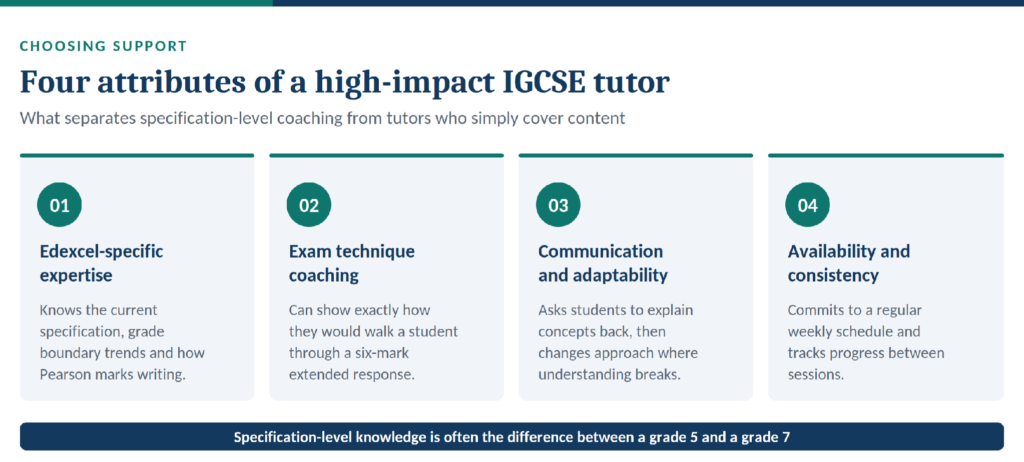
Figure 2: The four attributes that separate high-impact IGCSE tutors from those who simply cover content.
What to Look for in an Effective Tutor
Not every tutor who advertises “IGCSE” delivers the same standard of support. Weigh these four criteria before committing to regular sessions.
- Subject expertise with Edexcel specificity. Degree-level knowledge does not automatically produce strong IGCSE tutoring. Look for someone who has actively studied the current specification, understands grade boundary trends, and knows how Pearson marks extended writing.
- Demonstrated exam technique coaching. Strong content knowledge still loses marks without structure. Ask how they approach exam technique — and request a concrete example of coaching a student through a six-mark extended response.
- Communication and adaptability. The best tutors adjust in real time: they ask students to explain concepts back, spot exactly where understanding breaks down, and change approach. A tutor who lectures without checking comprehension is a warning sign, not a feature.
- Availability and consistency. Sporadic sessions rarely produce results. Look for a regular weekly schedule and progress tracking between sessions, with earlier material revisited when a concept has not consolidated.
Leveraging Official Resources Effectively
One of the most underutilised advantages available to Edexcel students is the full suite of materials published directly by Pearson — all free and unrestricted on the Pearson Edexcel International GCSE qualifications portal.
What is available at no cost
- Complete specification documents
- Specimen assessment materials
- Past papers going back several years
- Annual grade boundary data
- Subject-specific guidance notes for students and teachers
- Examiner’s reports cataloguing the most frequent student errors
Many students have no idea the examiner’s reports exist. Reading two or three for your highest-priority subjects is one of the most efficient preparation steps available to any IGCSE candidate.
Using third-party guides sensibly
Revision guides from established publishers such as CGP or Hodder Education offer useful content summaries — but they should complement the official specification, never replace it. Always check that what you are revising matches the current Pearson syllabus, since third-party guides occasionally lag behind specification updates.
Students who engage deeply with official past papers and mark schemes significantly outperform those who rely mainly on summary resources.
High-Pressure Subjects and How to Approach Them
Mathematics, the Sciences, and English Language generate disproportionate anxiety. Each presents distinct challenges — and knowing them helps you allocate revision time far more purposefully.
- Mathematics. Most students struggle not with foundational concepts but with multi-step problems where small errors compound. Use deliberate practice on worked examples rather than passive reading. When you get a question wrong, find the exact step where your reasoning diverged — not just the wrong final answer.
- Sciences (Biology, Chemistry, Physics). These reward precise terminology deployed accurately inside extended answers. Flashcards help with definitions, but writing explanations out from memory tests whether you truly understand a mechanism or merely recognise it.
- English Language and Literature. Often underestimated because the content feels familiar. Structured analytical writing needs consistent, timed paragraph practice. Examiners reward specific textual evidence, concise interpretation, and clear organisational logic — not impressionistic commentary.
Across every subject, early identification of weak areas plus consistent practice with Edexcel question types gives students a genuine, compounding advantage.
Common Mistakes That Hold Students Back
Even well-prepared students lose marks through avoidable habits. Recognising these early makes an enormous practical difference.
- Passive revision. Re-reading notes and highlighting textbooks feels productive but produces limited retention. Active retrieval — closing your notes and recalling from memory — outperforms passive review across all credible research on learning.
- Ignoring command words. Describe, explain, evaluate, justify, compare and assess each require a structurally different answer. Confusing “describe” with “explain” costs marks routinely, and most students only notice when papers come back.
- Starting too late. Beginning targeted revision six to eight weeks out works against how memory consolidates. Reliable retrieval under pressure needs repeated exposure over an extended period, not a last-minute burst.
- Not using mark schemes analytically. Checking whether you got the right answer is not enough. Study which phrases, terminology, and structural choices earned each mark point — that detail separates students scoring 7–9 from those plateauing at 5–6.
Addressing these habits early, with guidance from someone familiar with how Pearson marks its papers, produces compounding improvements across your entire subject load.
Conclusion
The Edexcel IGCSE is demanding, but it consistently rewards students who approach it with structure and purpose. Three pillars underpin high performance:
- Strong content knowledge
- Disciplined revision habits
- A clear understanding of how examiners assess answers
All three benefit from the right kind of support at the right stage.
Three things to do this week
Start early — do not wait for revision season to find your gaps.
Download two past papers and their mark schemes for your hardest subject.
Read one examiner’s report and note the errors it flags most often.
The students who perform best are rarely the ones with the most raw academic ability. They are the ones who prepare with the most intention.