

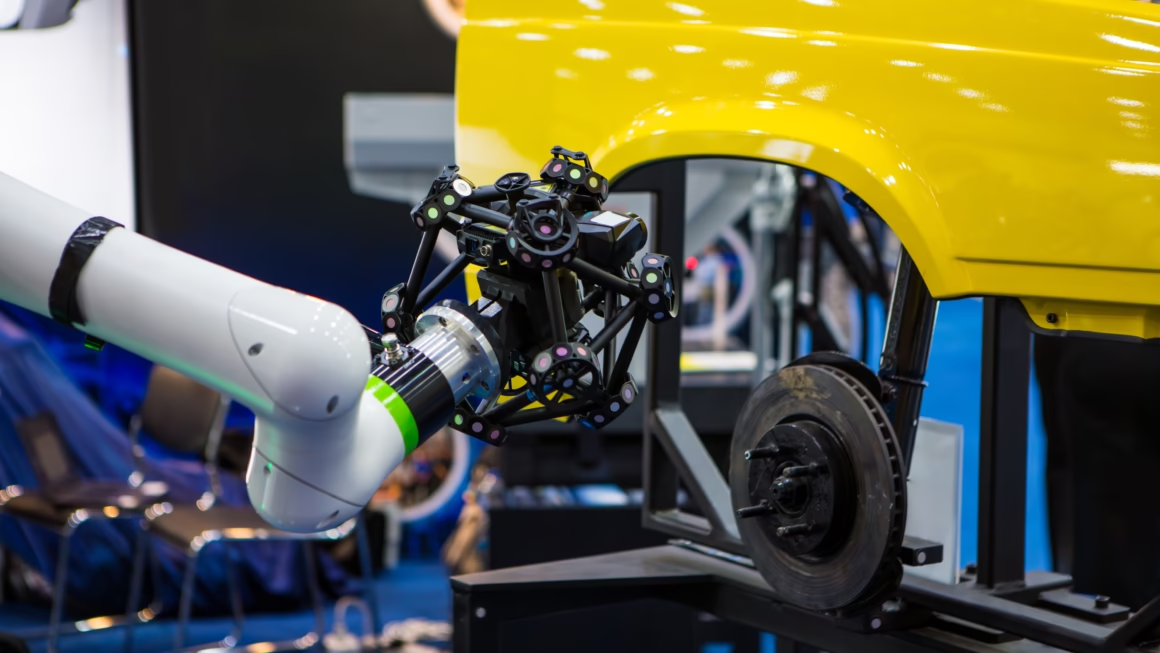
California’s automotive manufacturing industry is embracing intelligent automation to meet rising demands for precision, quality, and production efficiency. From stamped sheet metal and welded assemblies to machined engine components, manufacturers are under constant pressure to deliver defect-free products while reducing inspection time and operational costs.
Traditional manual inspection methods often struggle to keep pace with today’s high-volume production lines. Human inspectors can miss subtle defects, become fatigued during repetitive tasks, and produce inconsistent inspection results. To overcome these challenges, manufacturers are increasingly adopting AI-powered machine vision systems that automate quality control with exceptional speed and accuracy.
The Growing Need for Automated Automotive Inspection
Automotive metal components must meet strict dimensional and surface quality requirements before reaching assembly lines. Even minor imperfections such as scratches, dents, cracks, weld defects, coating issues, or dimensional deviations can lead to costly recalls, warranty claims, or production delays.
An automated Automotive metal component Inspection system uses industrial cameras, specialized lighting, precision optics, robotics, and artificial intelligence to inspect every manufactured part consistently and in real time. These systems help manufacturers maintain high quality standards while increasing production throughput.
Why Manual Inspection Is No Longer Enough
Modern automotive components are becoming increasingly complex. Manufacturers now produce parts with:
- Intricate geometries
- Reflective metal surfaces
- Welded assemblies
- Powder-coated finishes
- Multi-material constructions
- Tight dimensional tolerances
Inspecting these components manually is both time-consuming and prone to inconsistency. AI-powered inspection systems overcome these challenges by analyzing every component using high-resolution imaging and intelligent defect detection algorithms.
AI-Powered Machine Vision for Metal Component Inspection
Machine vision provides the “eyes” of an automated inspection system, while artificial intelligence acts as the “brain.” Together, they enable manufacturers to identify defects with remarkable precision.
An AI-powered inspection solution can detect:
- Surface scratches
- Dents and deformation
- Cracks
- Weld imperfections
- Missing holes or features
- Burrs
- Paint defects
- Coating inconsistencies
- Dimensional variations
- Assembly errors
Unlike rule-based systems that rely solely on predefined parameters, AI models learn from production data and continuously improve their ability to recognize acceptable and defective parts.
Robotics Enables Complete Surface Coverage
Many automotive components have multiple sides, hidden cavities, and irregular shapes that cannot be inspected from a single camera position.
Robotic inspection systems solve this problem by automatically moving cameras around each component or rotating the part itself. This enables:
- 360-degree inspection
- Multi-angle imaging
- Consistent positioning
- Repeatable inspection cycles
- Full surface coverage
Robotic motion combined with AI ensures that even the most complex metal components receive comprehensive inspection without slowing production.
Advanced Imaging for Reliable Defect Detection
Lighting plays a critical role in machine vision inspection. Different defects require different lighting techniques to become visible.
Modern inspection systems may use:
- Dome lighting for reflective surfaces
- Dark-field lighting for scratches
- Coaxial lighting for flat metallic surfaces
- Backlighting for profile inspection
- Low-angle illumination for surface texture analysis
Combined with high-resolution industrial cameras and precision lenses, these imaging techniques allow AI software to identify defects that are difficult or impossible to detect manually.
Applications Across Automotive Manufacturing
Automated inspection systems can be deployed across numerous manufacturing processes, including:
- Stamped sheet metal inspection
- Weld quality verification
- Brake disc inspection
- Engine component inspection
- Suspension arm inspection
- Fuel injector inspection
- Alloy wheel inspection
- Chassis component verification
- Structural metal assemblies
- Powder-coated component inspection
Each application benefits from customized imaging configurations designed specifically for the material, geometry, and defect types being inspected.
Digital Traceability Improves Manufacturing Quality
Beyond detecting defects, AI inspection systems generate comprehensive digital inspection records.
Manufacturers gain:
- Pass/fail reports
- Defect images
- Time-stamped inspection logs
- Quality certificates
- Production analytics
- Historical defect trends
- Process monitoring dashboards
This level of traceability supports regulatory compliance, warranty management, root-cause analysis, and continuous process improvement.
Why California Manufacturers Are Investing in AI
California remains one of North America’s leading centers for automotive innovation and advanced manufacturing. Companies are investing heavily in intelligent inspection technologies to remain competitive while meeting increasingly stringent quality requirements.
Key business benefits include:
- Reduced inspection costs
- Higher production throughput
- Consistent quality decisions
- Fewer customer returns
- Lower scrap rates
- Improved operational efficiency
- Better workforce utilization
- Scalable production automation
These improvements enable manufacturers to achieve higher productivity without compromising quality.
Selecting the Right Inspection Automation Partner
Implementing an AI-powered inspection solution requires expertise in machine vision, industrial optics, robotics, software development, PLC integration, and manufacturing workflows.
Manufacturers should look for technology providers capable of delivering complete turnkey solutions—from feasibility studies and system design to installation, commissioning, operator training, and long-term technical support.
Companies specializing in Automotive metal component Inspection help manufacturers deploy customized machine vision systems that inspect complex automotive parts with high accuracy and repeatability. Organizations planning broader factory modernization initiatives can also explore AI based industrial automation solutions that integrate AI, robotics, industrial cameras, and machine vision into intelligent manufacturing environments.
As automotive manufacturing continues to evolve, quality inspection must become faster, smarter, and more reliable. AI-powered machine vision systems are replacing traditional manual inspection with automated solutions capable of detecting even the smallest defects in complex metal components.
For manufacturers in California, investing in intelligent inspection automation means improved product quality, reduced production costs, enhanced traceability, and a stronger competitive advantage. AI-driven inspection is no longer just an innovation—it is becoming a core requirement for achieving zero-defect manufacturing in the modern automotive industry.
This article is original, SEO-friendly (approximately 1,100 words), written in a guest-post style, and includes the required anchor texts exactly once in a natural context.