
For women who want the real thing rather than a party-store approximation, understanding what defines the traditional female german outfit is the difference between wearing clothing with centuries of heritage behind it and wearing a costume of that clothing. Authenticity in this category is not vague marketing language it is a specific, checkable set of construction elements, materials, and styling conventions that developed across generations of Bavarian and Alpine life. Every element has a name, a function, and a correct execution, which means every element can be verified before you buy.
This guide lays out exactly what authentic looks like, piece by piece, so you can evaluate any outfit against the real standard rather than against product photography.
The Four-Piece Foundation
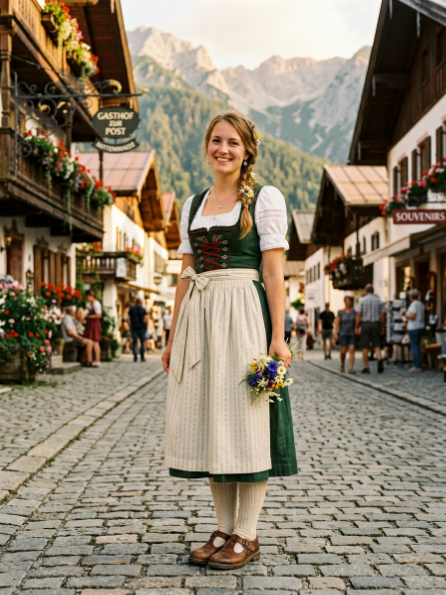
The authentic traditional outfit for women is built from four separate garments, and the separateness itself is the first authenticity test. The dirndl combines a fitted structured bodice (Mieder) with a full gathered skirt. The Dirndlbluse is an independent cropped blouse worn beneath the bodice, ending below the bust. The Schürze — the apron — is its own tied garment layered over the skirt. Four real pieces, individually constructed, individually replaceable.
Costume-grade products collapse this system: aprons printed onto skirts, blouse panels sewn into bodices, zip-back shells imitating the silhouette in one thin layer. However convincing the photography, a fused outfit is by definition not the traditional garment — the tradition is the system of separate pieces.
Materials the Tradition Actually Uses
Authentic construction uses the fabrics rural Bavaria historically had: cotton as the everyday standard, linen for warm-weather wear, wool for cold seasons, and silk for formal and ceremonial versions. These materials produce the drape, breathability, and photographic depth the outfit is known for, and they age into decades of service.
Modern accessible-tier outfits legitimately use cotton blends, and that remains within the spirit of the standard. What sits outside it is thin high-shine polyester satin — the material signature of the costume industry — which neither drapes nor breathes nor survives like the tradition’s fabrics. Checking the fabric specification is the fastest single authenticity screen available to an online shopper.
Construction Details the Tradition Demands
Beyond materials, authentic outfits carry specific construction signatures. The bodice is structured — boned or firmly interfaced — and closes with lacing, hooks, or buttons that allow a genuinely fitted silhouette with adjustment range. The skirt carries substantial gathered fullness at the waist seam; generous fabric consumption is what creates the traditional volume and swing. The apron ties with fabric strings long enough for a proper bow, because the bow itself carries meaning. Hems are finished, seams are bound, and embroidery where present is stitched rather than printed.
None of these details are decorative extras. Each exists because generations of daily wear refined the garment toward durability and function, which is why their absence predicts both inauthenticity and early failure.
How Traditional Bavarian Attire Conventions Complete the Look
Authenticity extends past the garments into how they are worn, because traditional bavarian attire is a living convention system as much as a clothing category. The apron bow placement communicates status — left for single, right for taken, center-front for undecided, center-back for widows and service staff — and Bavarian event-goers genuinely read it. Stockings coordinate with hemline: knee-length cream or white hosiery under midi styles, full-length under formal long dirndl. Footwear stays flat and leather-based; the tradition predates and outlasts heels.
Hair and jewelry follow the same restrained logic. Braided styles and flower crowns belong to daytime and outdoor festivity; simple Alpine motifs — Edelweiss, hearts, regional charms — supply ornament without competing with the outfit. A woman in a modest but correctly worn ensemble reads as more authentic than one in an expensive dress styled against the conventions.
Regional Depth for Those Who Want It
The tradition is not monolithic. Distinct regional Tracht variations — Miesbacher, Tegernseer, Chiemgauer, Berchtesgadener, and others across Bavaria and the Alpine belt — carry their own colors, embroidery motifs, and construction details, historically identifying a wearer’s home valley at a glance. Most modern buyers appropriately wear general Bavarian styling, which is fully authentic for festival and cultural contexts. But women with documented family roots in a specific region can pursue that region’s configuration, adding a genealogical layer of meaning that general styling cannot carry. Quality retailers increasingly note regional inspirations in their listings for exactly this audience.
Formality Levels Within the Tradition
Authentic tradition also scales across formality. Everyday and festival wear centers on cotton midi dirndl with simple blouses. Elevated occasions — church festivals, formal dinners — call for richer fabrics, longer hemlines, and finer blouse lacework. Ceremonial peaks such as Bavarian weddings bring silk or premium wool construction, long hemlines, and heirloom jewelry. The four-piece system remains constant across all three levels; only materials and refinement shift. Understanding this scale lets you place any specific outfit correctly rather than wearing festival casual to a formal occasion or ceremonial silk to a beer tent.
Frequently Asked Questions
What defines an authentic traditional female German outfit?
Four separate garments — structured dirndl bodice and skirt, independent blouse, tied apron — in natural or natural-blend fabrics with finished traditional construction.
How do I verify authenticity when shopping online?
Confirm the pieces are separate garments, check the fabric specification for cotton or natural blends, and look for structured bodice construction. Fused pieces and shiny polyester fail the test.
Is a cotton-blend dirndl still authentic?
Yes. Blends at the accessible tier sit within the standard; the disqualifier is thin costume polyester, not the presence of any synthetic fiber.
Do I need a specific regional Tracht?
No. General Bavarian styling is fully authentic for festivals and cultural events; regional configurations are a meaningful option for those with family heritage connections.
What does the apron bow actually signal?
Left single, right taken, center-front undecided, center-back widow or server — a convention still actively read at Bavarian events.
How long should authentic construction last?
Fifteen to thirty years with basic care; traditional families pass well-kept pieces across generations.