

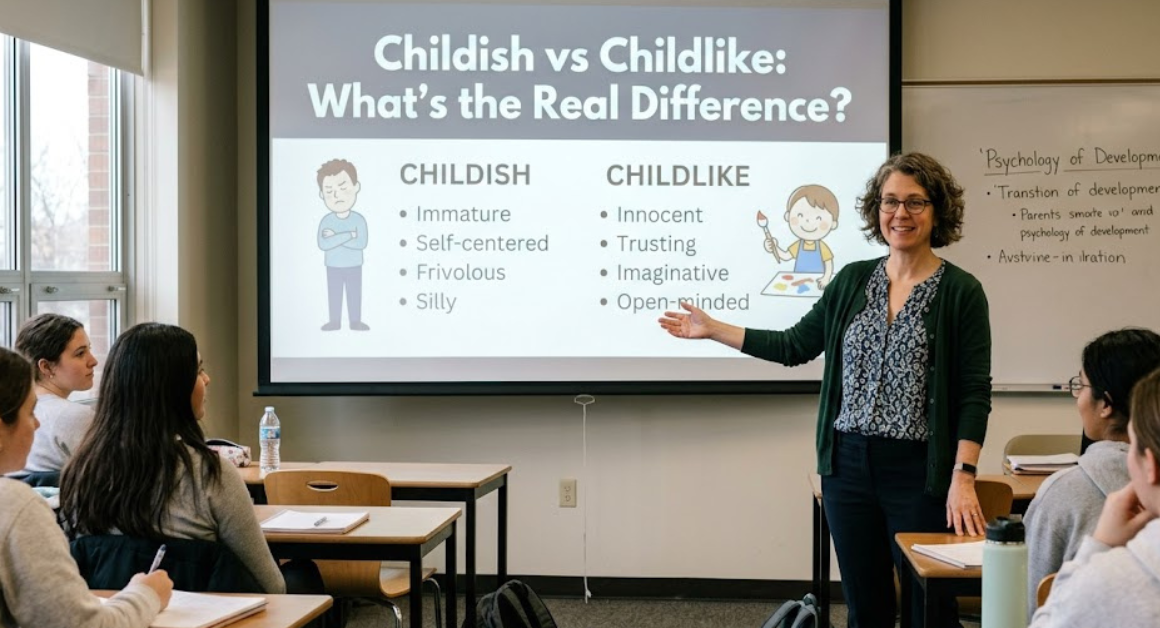
Childish vs childlike is one of the most commonly confused word pairs in English. At first glance, both words seem to describe behaviors associated with children. However, their meanings are quite different, and using the wrong one can completely change the message you want to convey.
If you’ve ever wondered whether someone is being childish or childlike, you’re not alone. Understanding this distinction can improve your writing, communication, and vocabulary. In this guide, we’ll explore the childish vs childlike difference, examine examples, and learn when each term is appropriate.
Understanding Childish and Childlike
Both words come from the noun child, but they carry very different emotional tones.
- Childish usually has a negative meaning.
- Childlike generally has a positive meaning.
Although both refer to qualities associated with children, one criticizes immature behavior while the other praises innocence and wonder.
What Does Childish Mean?
The word childish describes behavior that is immature, unreasonable, or inappropriate for someone’s age.
When adults act in ways that resemble the less desirable traits of children—such as throwing tantrums, refusing responsibility, or being petty—their behavior is often described as childish.
Examples of Childish Behavior
- Arguing over trivial matters.
- Refusing to admit mistakes.
- Throwing a temper tantrum.
- Sulking when things do not go your way.
- Making rude comments simply to upset others.
Example Sentences
- His childish reaction surprised everyone in the meeting.
- Stop being childish and discuss the problem calmly.
- They ended the friendship over a childish disagreement.
In most situations, calling someone childish is a criticism rather than a compliment.
What Does Childlike Mean?
The word childlike refers to positive qualities often associated with children, such as innocence, curiosity, imagination, honesty, and enthusiasm.
A childlike person maintains a sense of wonder and openness toward the world. Unlike childish behavior, childlike qualities are usually admired.
Examples of Childlike Traits
- Genuine curiosity.
- Excitement about new experiences.
- Creativity and imagination.
- Trust and sincerity.
- Appreciation for simple joys.
Example Sentences
- She approached the project with childlike enthusiasm.
- His childlike wonder made traveling with him enjoyable.
- The painting captures a childlike sense of imagination.
In many contexts, childlike is considered a compliment because it highlights positive emotional qualities.
Childish vs Childlike Difference Explained
The easiest way to remember the distinction is to focus on the emotional tone.
Childish = Immature
When someone behaves in a way that lacks maturity or responsibility, childish is the correct word.
Examples:
- Complaining excessively.
- Refusing to compromise.
- Acting selfishly.
Childlike = Innocent
When someone displays curiosity, joy, or wonder, childlike is the better choice.
Examples:
- Being fascinated by nature.
- Showing genuine excitement.
- Having a vivid imagination.
Think of it this way:
- Childish behavior often creates problems.
- Childlike qualities often enrich life.
Why People Confuse These Words
People often mix up these terms because both originate from the same root word and both describe characteristics associated with children.
However, English frequently creates words with similar structures but different meanings. In this case, the suffixes help shape the tone:
- -ish can suggest an undesirable or lesser quality.
- -like often means possessing characteristics similar to something in a positive or neutral way.
As a result, the meanings developed in different directions over time.
Common Examples in Everyday Life
Understanding the distinction becomes easier when you see it in real situations.
At Work
Childish:
An employee refuses to cooperate because they did not get their preferred assignment.
Childlike:
An employee eagerly explores new ideas and approaches problems creatively.
In Relationships
Childish:
Someone gives their partner the silent treatment after a minor disagreement.
Childlike:
Someone expresses affection openly and enjoys simple moments together.
In Learning
Childish:
Refusing feedback because of pride.
Childlike:
Asking questions and staying curious about new topics.
How to Remember the Difference
A simple memory trick can help.
Use This Rule
Childish = Negative
Think of behaviors that make a person seem less mature than expected.
Childlike = Positive
Think of qualities that make life more joyful, creative, and meaningful.
Whenever you’re unsure, ask yourself:
“Am I describing immaturity or innocence?”
If it’s immaturity, choose childish.
If it’s innocence or wonder, choose childlike.
Common Mistakes to Avoid
Many writers accidentally use these words interchangeably. Here are some examples of incorrect and correct usage.
Incorrect
- Her childish excitement about the holiday was contagious.
Correct
- Her childlike excitement about the holiday was contagious.
The excitement is positive, so childlike fits better.
Incorrect
- His childlike refusal to apologize annoyed everyone.
Correct
- His childish refusal to apologize annoyed everyone.
Refusing to apologize is immature, making childish the appropriate choice.
Synonyms for Childish
Depending on the context, similar words include:
- Immature
- Petty
- Juvenile
- Foolish
- Silly
- Irresponsible
These words often emphasize a lack of maturity or good judgment.
Synonyms for Childlike
Words with similar meanings include:
- Innocent
- Wonder-filled
- Trusting
- Pure
- Imaginative
- Playful
These terms highlight positive characteristics often associated with children.
When Childlike Becomes a Strength
Modern society often values maturity, responsibility, and professionalism. However, retaining certain childlike qualities can be incredibly beneficial.
People who maintain curiosity tend to learn faster. Those who preserve imagination often become more creative problem-solvers. A sense of wonder can also improve emotional well-being and make everyday experiences more enjoyable.
In other words, being childlike does not mean being immature. It means keeping the best qualities of childhood while still functioning as a responsible adult.
FAQs
What is the difference between childish and childlike?
Childish refers to immature or irresponsible behavior, while childlike refers to positive qualities such as innocence, curiosity, and wonder.
Is childish always negative?
In most situations, yes. Childish usually implies behavior that is inappropriate, immature, or lacking emotional maturity.
Is childlike a compliment?
Generally, yes. Calling someone childlike often suggests they possess positive traits such as creativity, enthusiasm, and sincerity.
Can an adult be childlike?
Absolutely. Many adults maintain childlike curiosity, imagination, and appreciation for life’s simple pleasures while remaining mature and responsible.
Can someone be both childish and childlike?
Yes. A person may display childlike creativity and enthusiasm while occasionally acting childish in certain situations. The two qualities are not mutually exclusive.
Which word should I use in professional writing?
Choose childish when discussing immaturity or poor behavior. Choose childlike when describing innocence, wonder, creativity, or positive emotional qualities.
Conclusion
Understanding the childish vs childlike distinction can help you communicate more precisely and avoid common vocabulary mistakes. While the two words share the same root, they express very different ideas. Childish points to immaturity and poor judgment, whereas childlike celebrates innocence, curiosity, and imagination.
The next time you’re choosing between these terms, remember a simple rule: childish criticizes behavior, while childlike praises positive qualities. Mastering this difference will make your writing clearer, more accurate, and more effective.