

What Is the Correct Symbol for Fluorine?
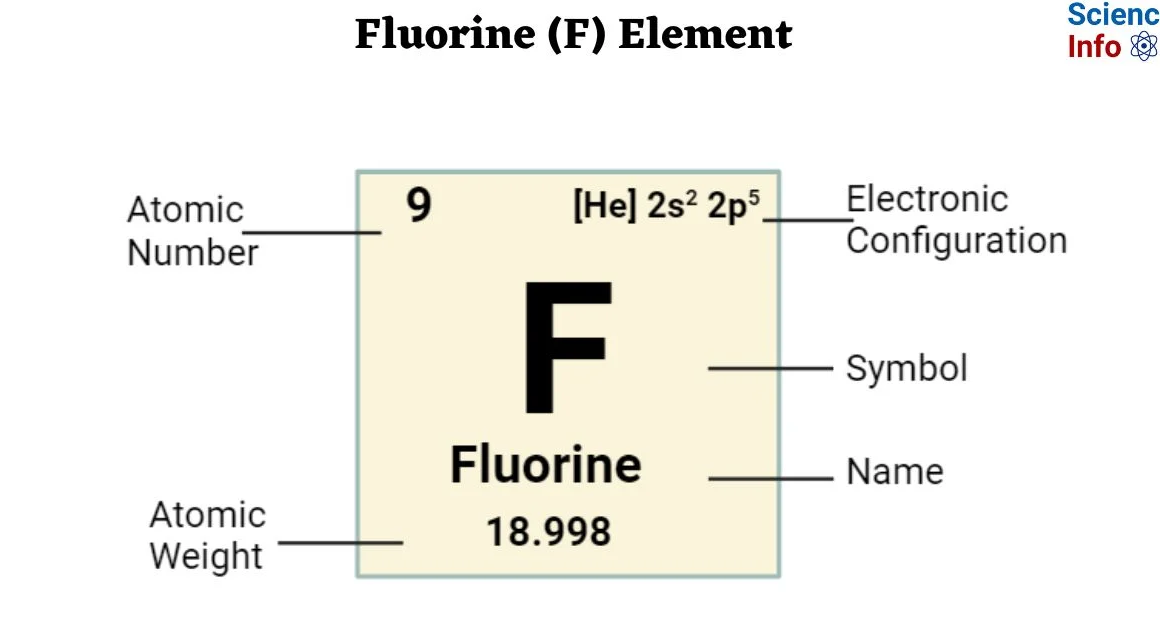
The correct symbol for fluorine is F. It is the chemical symbol used internationally to identify fluorine on the periodic table, in chemical equations, laboratory notes, scientific publications, and educational materials. The symbol consists of a single uppercase letter, F, because fluorine’s name begins with the letter F and there is no need for a second letter to distinguish it from another element.
Fluorine is a chemical element with the atomic number 9. It belongs to Group 17 of the periodic table, a family commonly known as the halogens. Although the symbol looks simple, understanding what F represents is important because chemical symbols provide a compact way of communicating information about elements and their atoms.
When someone asks for the correct symbol for fluorine, they are usually looking for the letter F, rather than the full word “fluorine.” It is also important to write the symbol correctly. Chemical symbols are case-sensitive, so F is correct, while f is not the standard symbol for fluorine.
Why Is Fluorine Represented by F?
Chemical symbols are designed to make chemistry easier to read and communicate. Most symbols are based on the English or historical name of an element. In fluorine’s case, the symbol F comes directly from its name. Because F is not already assigned to another element, a single letter is sufficient.
The capitalization of the symbol follows an important convention. The first letter of an element symbol is always capitalized. If an element has a two-letter symbol, the second letter is lowercase. For example, chlorine is Cl, oxygen is O, and nitrogen is N. Fluorine is especially straightforward because its symbol requires only one letter: F.
This distinction may seem minor, but capitalization can completely change how a chemical symbol is interpreted. Writing F clearly identifies fluorine, whereas writing a lowercase f does not follow the official element-symbol convention. Learning these rules early makes it much easier to read formulas, equations, periodic tables, and scientific information accurately.
Fluorine on the Periodic Table
Fluorine occupies the ninth position on the periodic table, which means its atomic number is 9. Its position is significant because the periodic table organizes elements according to their atomic numbers and recurring chemical properties. Fluorine is found in Group 17, alongside other halogens such as chlorine, bromine, iodine, and astatine.
An electrically neutral fluorine atom contains nine protons and nine electrons. Its electron arrangement gives it seven electrons in its outermost shell. Because atoms tend to become more stable when their outer electron shells are filled, fluorine has a strong tendency to gain one electron when forming an ion.
The resulting ion is called a fluoride ion and has a charge of −1, written as F⁻. This is different from the neutral fluorine atom represented simply by F. Understanding this difference is useful because the same element can appear in different forms depending on whether it is neutral, ionized, or bonded to another element.
Fluorine vs. Fluoride: What Is the Difference?
One common source of confusion is the difference between fluorine and fluoride. The element itself is fluorine, and its chemical symbol is F. Fluoride refers to the negatively charged ion formed when a fluorine atom gains one electron. Its symbol is F⁻.
The distinction becomes clearer when looking at ordinary chemical compounds. Sodium fluoride, for example, is written as NaF. In this compound, sodium forms a positively charged sodium ion while fluorine exists as fluoride, carrying a negative charge. The formula therefore represents a compound made from sodium and fluoride ions.
Fluoride can also appear in many other compounds. The important point is that F identifies the element fluorine, while F⁻ specifically represents a fluoride ion. They are related but should not be treated as exactly the same notation. This small difference is particularly important when writing chemical equations or explaining ionic compounds.
What Are the Key Facts About Fluorine?
Fluorine has several characteristics that make it one of the most chemically interesting elements. It has the atomic number 9 and the chemical symbol F. Under standard conditions, elemental fluorine exists as a pale yellow gas and naturally occurs as a diatomic molecule.
A diatomic molecule contains two atoms of the same element. Consequently, elemental fluorine is commonly represented by the molecular formula F₂, rather than simply F, when describing the substance made up of fluorine molecules. Here, F is the element symbol, while F₂ tells us that each molecule contains two fluorine atoms.
Fluorine is also extremely reactive. It is the most electronegative element on the periodic table, meaning it has a very strong tendency to attract electrons toward itself when forming chemical bonds. This property helps explain why fluorine readily combines with many other elements and why fluorine-containing compounds are widespread in chemistry.
How F Is Used in Chemical Formulas
The symbol F appears in a wide range of chemical formulas. Its role depends on the substance being described. For instance, hydrogen fluoride is represented by HF, meaning the compound contains hydrogen and fluorine.
Another familiar example is CaF₂, the chemical formula for calcium fluoride. The formula indicates that each unit contains one calcium atom for every two fluorine atoms. Similarly, sodium fluoride is represented by NaF, while aluminum fluoride is written as AlF₃.
These formulas demonstrate why knowing the correct symbol for fluorine is so useful. Once you recognize F, you can quickly identify fluorine in unfamiliar chemical formulas. Chemical notation essentially works like a compact language, allowing scientists and students to communicate the composition of substances without repeatedly writing out full element names.
The Role of Fluorine in Everyday Life
Although elemental fluorine is highly reactive and requires careful handling, fluorine compounds have many practical applications. Fluorine-containing substances are used in areas ranging from materials science to medicine, manufacturing, and dental care.
Fluoride compounds are particularly well known in oral health. Fluoride can help strengthen tooth enamel and make teeth more resistant to acid-related damage. This is why fluoride compounds have historically been included in many dental-care products and, in some regions, public water supplies.
Fluorine chemistry is also important in the development of specialized materials. Certain fluorine-containing polymers have properties such as chemical resistance, low friction, and stability under demanding conditions. These characteristics make fluorinated materials useful in industrial and technological applications.
Why Chemical Symbols Need to Be Written Correctly
Writing an element symbol correctly is more than a matter of appearance. Chemical symbols carry precise scientific meanings, so an incorrect symbol can create confusion or make a formula invalid. For fluorine, the correct representation is F, with an uppercase F.
Students sometimes make mistakes by writing the element name instead of its symbol, using lowercase letters, or confusing the element symbol with the formula of the elemental substance. For example, F and F₂ are not interchangeable in every context. F identifies the element or one fluorine atom, while F₂ represents a molecule containing two fluorine atoms.
Careful notation becomes increasingly important as chemistry becomes more advanced. Balancing equations, calculating molar masses, determining oxidation states, and interpreting molecular structures all depend on accurate chemical symbols and formulas. A single misplaced letter or number can change the meaning of an entire chemical expression.
Fluorine’s Position Among the Halogens
Fluorine is the first member of the halogen group in the periodic table. The other commonly discussed halogens include chlorine, bromine, iodine, and astatine. These elements share certain chemical characteristics because they have similar outer-electron arrangements.
Fluorine’s position at the top of Group 17 contributes to its exceptional reactivity. Compared with the heavier halogens, fluorine has a very small atomic size and a particularly strong attraction for electrons. These characteristics contribute to its high electronegativity and its tendency to form compounds.
Despite belonging to the same family, fluorine should not simply be treated as a smaller version of chlorine or bromine. Its chemistry has distinctive features. Knowing its symbol, F, is the first step toward recognizing its place within this broader family of elements.
Common Mistakes When Writing the Fluorine Symbol
One of the simplest mistakes is writing f instead of F. In chemistry, element symbols use standardized capitalization, so fluorine must be represented by an uppercase F. Lowercase writing may look harmless in ordinary text, but scientific notation follows strict conventions.
Another mistake is confusing F with F₂. The first is the chemical symbol for fluorine, while the second is the molecular formula for elemental fluorine in its diatomic form. The subscript 2 is meaningful because it tells us that two fluorine atoms make up one molecule.
A third mistake is confusing fluorine with fluoride. Fluorine is represented by F, while the fluoride ion is represented by F⁻. Recognizing these differences helps prevent errors when interpreting ionic compounds, chemical equations, and laboratory information.
How to Remember the Correct Symbol for Fluorine
The easiest way to remember the symbol is also the simplest: fluorine starts with F, so its symbol is F. Unlike elements with symbols based on older names, fluorine does not require memorizing an unusual abbreviation.
It can also help to connect the symbol with fluorine’s atomic number. Fluorine is element number 9, so remembering “fluorine = F = 9” provides three useful pieces of information together. With regular exposure to the periodic table, the association quickly becomes automatic.
If you are studying chemistry, practice identifying fluorine in different contexts. Look for F in formulas such as HF, NaF, CaF₂, and AlF₃. This helps you understand not only the symbol itself but also how fluorine behaves when it combines with other elements.
Final Answer: What Is the Correct Symbol for Fluorine?
The correct symbol for fluorine is F. Fluorine is element number 9 on the periodic table and belongs to Group 17, the halogen family. Its single-letter symbol is written with a capital F, following the international conventions used for chemical elements.
It is useful to distinguish F from F₂ and F⁻. F is the element symbol, F₂ represents elemental fluorine as a diatomic molecule, and F⁻ represents the fluoride ion. Each notation communicates different information, even though they all involve the same element.
Once you understand this distinction, the symbol becomes easy to recognize in chemical formulas and scientific discussions. Whether you are learning basic chemistry, studying the periodic table, or simply looking up an element symbol, the answer remains straightforward: the correct symbol for fluorine is F.
You May Also Raed: Englishtistic