

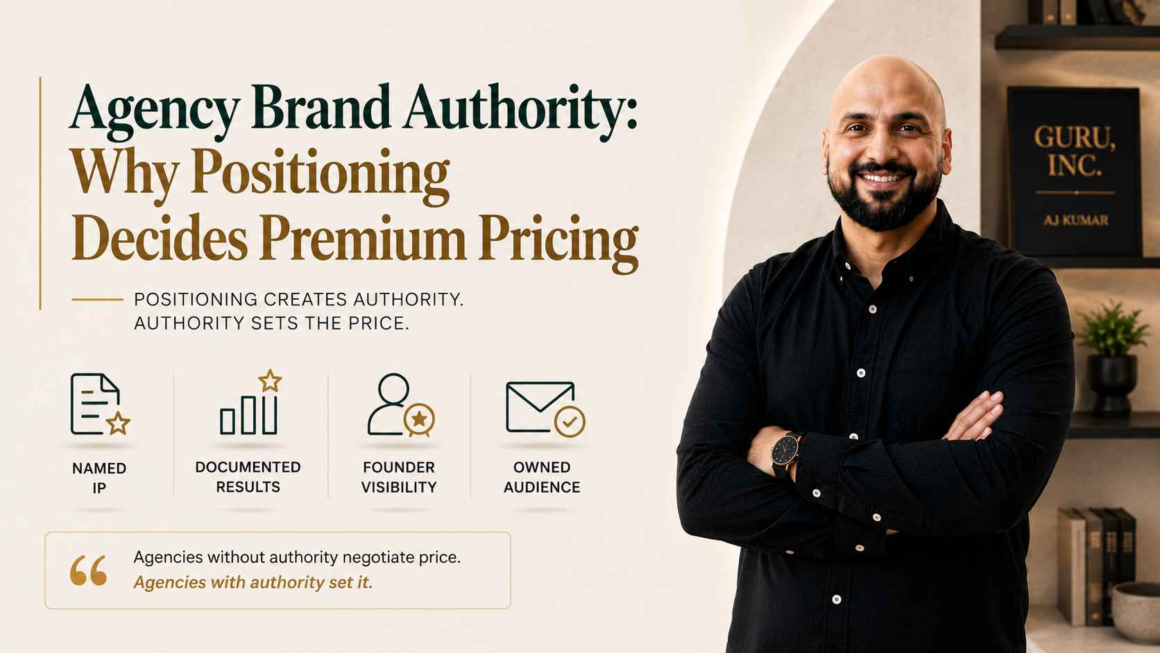
Building a premium agency brand is about much more than choosing an expensive-looking logo, creating a polished website, or increasing your prices. If you want to understand how to build agency brand authority positioning premium, you need to think about the complete experience your agency creates in the mind of potential clients.
Premium positioning happens when people see your agency as specialized, credible, valuable, and different from the many alternatives competing for their attention. The strongest agencies do not simply tell prospects that they are experts. Their messaging, content, offers, case studies, communication, and client experience all reinforce the same idea.
The good news is that premium authority can be built deliberately. You do not necessarily need decades of experience or a huge team. You need a clear position, consistent proof, strong communication, and the discipline to stop presenting your agency like a commodity.
Start With a Clear and Specific Agency Position
The first step in learning how to build agency brand authority positioning premium is defining exactly what your agency wants to be known for. A vague agency description such as “we provide digital marketing services” gives prospects very little reason to remember you. It also puts you into direct competition with thousands of similar businesses.
A stronger position identifies the type of client you serve, the problem you solve, and the particular approach you use. For example, an agency might specialize in helping B2B software companies improve qualified lead generation through strategic content and conversion optimization. That statement immediately creates more distinction than simply calling the business a marketing agency.
Specificity does not mean permanently limiting your business. It means giving the market a clear mental category for your company. Once people associate your agency with a particular problem or outcome, building authority becomes much easier because your content and proof can consistently reinforce that association.
Define What Premium Means for Your Agency
Premium positioning should never be confused with simply charging more money. A high price without a convincing reason creates skepticism rather than authority. A premium agency needs to communicate why its work produces greater value than cheaper alternatives.
Think about what premium clients actually purchase. They are often buying expertise, confidence, speed, strategic thinking, reduced risk, better decision-making, and a smoother experience. They may also want access to specialized knowledge that would be difficult to develop internally.
Your agency therefore needs to define its premium value proposition. Ask yourself what clients receive beyond the basic deliverable. If another agency provides a website, perhaps your agency provides a conversion-focused digital growth system backed by research, strategic positioning, analytics, and ongoing optimization. The difference is not merely the deliverable. It is the depth of thinking surrounding it.
Build Authority Through Demonstrable Expertise
Authority becomes powerful when you can demonstrate expertise rather than repeatedly claiming it. Saying that your agency is “world-class” or “industry-leading” is easy. Showing prospects how you think is considerably more convincing.
Create content that answers difficult questions within your niche. Publish strategic guides, original observations, detailed breakdowns, case studies, industry analyses, and practical frameworks. Instead of producing generic posts that could have been written by anyone, explain the decisions that experienced professionals make.
You can also use your existing client work as an educational resource. Discuss the challenge, explain the strategic reasoning, describe the implementation, and share the measurable outcome when appropriate. Even when confidential information cannot be disclosed, anonymized examples can demonstrate how your agency approaches complex situations.
Create a Brand Message That Sounds Confident
Premium brands generally communicate with clarity rather than desperation. Your messaging should tell prospects what you do, who you help, why your approach matters, and what makes your agency different.
Avoid filling your website with exaggerated claims, excessive buzzwords, or phrases such as “best-in-class,” “revolutionary,” and “next-generation” unless you can substantiate them. Sophisticated buyers are often more impressed by precise language than dramatic adjectives.
A confident agency might say, “We help established professional-service firms turn complex expertise into high-converting digital experiences.” That statement feels more authoritative because it identifies a specific audience and business problem. The message creates a clear expectation rather than trying to impress everyone simultaneously.
Use Case Studies as Premium Positioning Assets
Few things strengthen agency authority more effectively than relevant proof. Case studies allow potential clients to see that your agency has successfully handled situations similar to theirs.
A strong case study should go beyond showing a pretty final design or mentioning that a campaign “performed well.” Explain the original situation, the business objective, the obstacles involved, the strategic decisions made, and the results achieved. Where possible, use meaningful metrics to demonstrate impact.
The quality of your case studies also matters. Treat them as marketing assets rather than afterthoughts. Good writing, clean visuals, clear storytelling, and useful business context can make ordinary project documentation feel considerably more valuable. A prospect should finish reading a case study understanding not only what you delivered, but why your agency was the right partner.
Develop a Distinctive Point of View
One of the most effective ways to build authority is to have opinions. Agencies that attempt to remain neutral on everything often become forgettable.
A distinctive point of view does not mean creating controversy simply to attract attention. It means developing informed perspectives about your industry. You might believe that companies waste too much money on short-term campaigns, that certain popular marketing tactics are outdated, or that agencies should be compensated based on strategic value rather than hours.
Explain why you hold those positions. Support them with experience, evidence, observations, and examples. Over time, these opinions become part of your brand identity. People begin to recognize not just what your agency does, but how your agency thinks.
Upgrade Your Agency’s Visual Identity
Visual presentation cannot create authority by itself, but poor presentation can weaken otherwise excellent positioning. If you want to understand how to build agency brand authority positioning premium, your visual identity deserves attention.
Your website, typography, photography, graphics, proposals, presentations, social profiles, and client documents should feel like they belong to the same company. Consistency creates professionalism and makes the agency appear more established.
Premium design does not necessarily mean complicated design. In many cases, restraint works better. Clear typography, thoughtful spacing, strong imagery, consistent layouts, and purposeful use of color can communicate confidence. The goal is not to make everything flashy. The goal is to make every visual decision feel intentional.
Make Your Website Sell Expertise Instead of Services
Many agency websites are essentially digital menus. They list services, packages, technologies, and generic benefits. A premium agency website should function more like a persuasive business argument.
Your homepage should quickly establish who you help and the outcome you create. Your service pages should explain your methodology and strategic value rather than simply listing tasks. Your case studies should provide evidence. Your about page should establish credibility without turning into an autobiography.
Consider adding a strong insights section as well. High-quality articles can demonstrate your expertise before a prospect ever schedules a conversation. When potential clients repeatedly encounter useful ideas from your agency, your brand begins to occupy a position of authority in their minds.
Be Selective About Clients and Opportunities
Premium positioning becomes difficult when an agency says yes to absolutely everything. If your website says you work with every industry, every company size, and every type of project, your specialization becomes difficult to understand.
Being selective can actually increase perceived value. This does not mean rejecting good opportunities unnecessarily. Instead, establish criteria for the projects where your agency can create exceptional results.
You can communicate this selectivity through your positioning. Explain the type of organizations you are best suited to support, the challenges you handle particularly well, and the situations where your methodology produces the greatest value. The message becomes, “We are not for everyone, but we may be exactly right for you.”
Improve the Entire Client Experience
Premium positioning is ultimately tested through experience. An agency can have an impressive website and excellent marketing, but if communication is disorganized and project delivery feels chaotic, the premium perception disappears quickly.
Look carefully at every client touchpoint. How quickly do you respond to inquiries? How professional is your proposal? Is your onboarding process organized? Do clients understand what happens next? Are meetings purposeful? Are reports easy to understand? Do you communicate proactively when something changes?
Small improvements compound. A structured onboarding process, thoughtful welcome materials, clear timelines, strategic check-ins, and concise reporting can make clients feel that they are working with a serious professional organization rather than simply another freelancer or service provider.
Price According to Value and Positioning
Pricing is one of the most visible signals in premium positioning, but it should come after your value proposition has been established. Increasing prices without improving positioning rarely creates sustainable premium status.
Instead, develop offers around outcomes, complexity, expertise, and business value. If your agency helps a company solve a high-value problem, the conversation should not revolve exclusively around how many hours your team will spend completing tasks.
This also means avoiding unnecessary discounting. Constant discounts can train prospects to view your services as negotiable commodities. If you need to offer flexibility, consider changing scope, deliverables, timing, or engagement structure rather than immediately reducing the value of your work.
Build Social Proof Beyond Testimonials
Testimonials are useful, but premium authority can be strengthened through multiple forms of social proof. Client logos, industry recognition, media mentions, speaking appearances, partnerships, published research, expert interviews, and measurable results can all contribute.
The key is relevance. Ten generic testimonials may be less persuasive than three detailed testimonials from respected companies in your target market. Social proof works best when it reduces the specific uncertainty a prospect has before hiring you.
You can also encourage clients to describe the transformation they experienced. Instead of simply saying your team was “great to work with,” a stronger testimonial might explain how your strategic recommendations helped the company improve conversion rates, shorten its sales cycle, or enter a new market.
Create Consistency Across Every Channel
Your premium positioning should not exist only on your website. A prospect may discover your agency through LinkedIn, Google, a podcast, a referral, an email, or a conference presentation. Every channel should reinforce the same core positioning.
This does not mean posting identical content everywhere. Your tone and visual identity can remain consistent while the format changes according to the platform. The important thing is that people should recognize the same expertise and point of view wherever they encounter your brand.
Consistency also builds familiarity. A single article rarely establishes authority. Regularly sharing useful insights over months creates a stronger association between your agency and the problem you specialize in solving.
Measure Whether Your Positioning Is Working
The final part of how to build agency brand authority positioning premium is measuring whether the market actually perceives the change. Do not judge positioning exclusively by likes, impressions, or follower counts.
Look at the quality of inbound inquiries. Are prospects mentioning specific expertise when they contact you? Are you attracting larger or better-fit companies? Are prospects comparing you based on strategic value rather than simply asking for your lowest price? Are referral partners describing your agency in the way you want to be known?
You can also interview existing clients and ask what they believe your agency does best, why they chose you, and what they would say about your company to another business owner. Their answers can reveal whether your intended positioning matches your actual market perception.
Final Thoughts on Building a Premium Agency Brand
Learning how to build agency brand authority positioning premium is really about creating alignment. Your niche, messaging, expertise, proof, design, pricing, content, sales process, and client experience should all communicate the same fundamental idea.
Do not try to look premium before becoming valuable. Build genuine expertise first, document the results, communicate your thinking clearly, and create an experience that reflects the quality of your work. Then let the premium positioning emerge from those foundations.
The strongest agency brands are rarely the ones shouting the loudest. They are the ones that become easy to trust because their specialization is clear, their knowledge is visible, their results are credible, and their entire customer experience feels intentional. When those elements work together, premium positioning stops being a marketing trick and becomes a natural reflection of the value your agency provides.
You May Also Raed: Englishtistic