
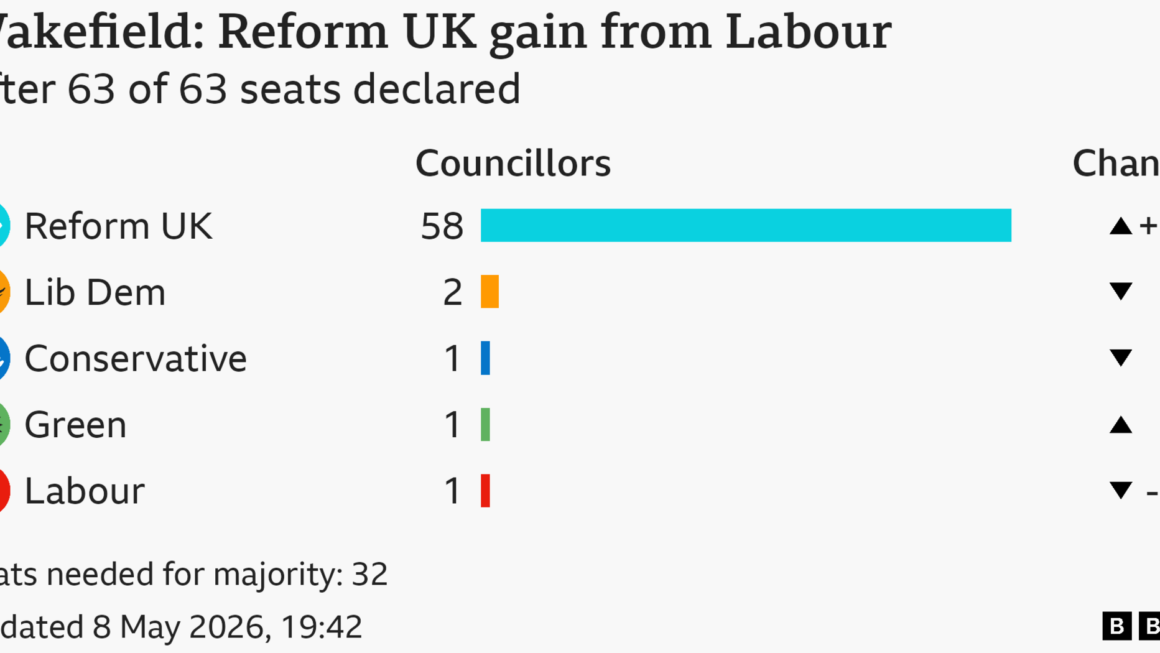
The Wakefield local elections 2026 produced a striking result, with Reform UK making a major breakthrough across the district and winning the overwhelming majority of the seats contested. The election took place on 7 May 2026, with voters choosing councillors across 21 wards. When the results were declared, Reform UK had secured 58 of the 63 councillor positions available, while the Liberal Democrats won two seats, and the Green Party, Conservative Party and Labour Party each won one.
The scale of the result makes the 2026 election particularly significant for local politics in Wakefield. It was not simply a close contest between several established parties. Instead, the results showed a dramatic shift in the balance of power, with Reform UK winning seats across urban, suburban and more rural parts of the district. In several wards, the winning candidates also recorded relatively comfortable vote totals compared with their nearest competitors.
For residents, however, elections are about much more than party labels. Local councillors have a direct influence on issues such as council services, neighbourhood priorities, planning, roads, housing, waste collection and community investment. That means the outcome of the Wakefield local elections 2026 will be judged not only by the size of Reform UK’s victory but also by what the new council does with its mandate.
What Happened in the Wakefield Local Elections 2026?
The official results show just how dramatic the change was. Reform UK won 58 councillor positions across the 21 wards, leaving the party with a dominant position on Wakefield Council. The Liberal Democrats took two seats, while the Green Party, Conservatives and Labour each secured one. The result represents a substantial change from the more traditional party competition that has historically shaped local politics in many parts of the district.
Reform UK’s success was not limited to one particular part of Wakefield. Candidates won across places including Ackworth, Airedale and Ferry Fryston, Featherstone, Hemsworth, Horbury and South Ossett, Ossett, Pontefract, Stanley and Outwood, and several of the Wakefield wards themselves. In other words, the result was geographically broad rather than being driven by a single local area.
Some contests were particularly close. In Ackworth, North Elmsall and Upton, for example, the official results recorded a very small margin between the candidates at the relevant cutoff. Similar narrow margins appeared elsewhere, showing that although Reform UK dominated the overall seat count, individual races could still be highly competitive. This is an important point because a large council majority does not mean every ward produced an overwhelming vote for one party.
Reform UK’s Dominant Performance Across Wakefield
The biggest story from the Wakefield local elections 2026 was undoubtedly Reform UK’s performance. The party secured three councillors in many of the multi-member wards, including places such as Airedale and Ferry Fryston, Crofton, Ryhill and Walton, Featherstone, Hemsworth, Horbury and South Ossett, Ossett, Pontefract North and Pontefract South.
The results also show that Reform UK’s support was spread across different types of communities. The party performed strongly in former industrial areas as well as suburban and semi-rural wards. In Wakefield Rural, for instance, all three elected councillors were Reform UK candidates. In Stanley and Outwood East, Reform UK also secured all three available positions. These results underline the breadth of the party’s breakthrough in the district.
Another interesting feature was the number of wards where Reform UK candidates finished comfortably ahead of several established-party candidates. In South Elmsall and South Kirkby, three Reform UK candidates were elected, while the party also took all three seats in Wakefield West. The overall picture therefore suggests that voters in 2026 were willing to move away from the traditional political choices and give Reform UK a substantial role in running the council.
How Did Labour and the Other Parties Perform?
Labour’s result was one of the most notable aspects of the election because the party won only one seat across the district. That seat came in Wakefield East, where Yubi Ayub was elected alongside Reform UK candidates Wayne Beddoes and Steve Parker. The result represents a major setback for Labour at local level, particularly given the party’s historic strength across parts of West Yorkshire.
The Conservative Party also had a limited outcome, winning one seat in Wakefield South. Nadeem Ahmed was elected there, while Reform UK candidates also secured two positions. Although the Conservatives did not disappear from the council completely, the overall results demonstrate how much ground the party lost to Reform UK in a large number of wards.
The Green Party and Liberal Democrats managed to maintain a small presence. The Green Party won one seat in Wakefield North, while the Liberal Democrats secured two seats overall. Wakefield North was particularly unusual because the ward produced a more divided result, with a Green candidate and Reform UK candidates taking the available seats. This demonstrates that even within an election dominated by one party, local political preferences could vary considerably from ward to ward.
Voter Turnout in the 2026 Election
Turnout is always an important part of understanding a local election, and Wakefield’s 2026 figures provide an interesting picture. Across the district, 98,402 ballot papers were recorded and overall voter turnout was 36.6%. That means fewer than four in ten eligible voters participated in the election.
There was considerable variation between wards. Wakefield Rural recorded the highest turnout at 45%, while Horbury and South Ossett reached 44%. Wrenthorpe and Outwood West recorded 43%, with Stanley and Outwood East and Crofton, Ryhill and Walton both reaching 42%. At the other end of the scale, Airedale and Ferry Fryston and Hemsworth each recorded turnout of 29%.
These differences matter because local elections can sometimes be decided by relatively small numbers of votes. When turnout is low, motivated groups of voters can have a disproportionately strong influence on the final result. The Wakefield figures therefore provide an important reminder that local political campaigns still depend heavily on getting supporters to actually cast a ballot.
What the Results Could Mean for Wakefield Council
With 58 of the 63 seats going to Reform UK, the new political balance gives the party a very strong position within Wakefield Council. Such a large majority can make it easier for the administration to pursue its priorities without having to negotiate extensively with opposition groups on every major decision. At the same time, having such a large majority brings greater responsibility because residents will expect clear results from the new administration.
The practical issues facing the council are likely to matter more to residents than the headline numbers. Local government affects everyday services, and councillors have to deal with decisions involving budgets, local infrastructure, community facilities, planning, housing and public services. A strong electoral mandate can provide political stability, but it does not automatically solve the financial and operational challenges faced by councils.
For Reform UK, the key question after the Wakefield local elections 2026 is therefore how effectively it can turn electoral support into visible local improvements. Winning an election and governing successfully are two different tasks. Residents will ultimately judge the new council on its decisions, communication and ability to deliver on the issues that matter in their communities.
Why the Wakefield Election Matters Beyond Party Politics
The Wakefield local elections 2026 are significant because they demonstrate how quickly local political landscapes can change. A council that might previously have been associated strongly with established parties can look completely different after one election. The scale of Reform UK’s victory makes Wakefield an especially useful example of the changing political dynamics in parts of England.
There is also a wider lesson about the importance of local elections. National politics often receives most of the attention, but local councillors make decisions that can affect residents on a very practical level. A national political debate might dominate television coverage, while a council decision about a road, planning application, local facility or community service can have a more immediate impact on everyday life.
The 2026 result also shows why looking beyond the overall seat count is worthwhile. The figures reveal significant differences in turnout, vote shares and margins between wards. Some candidates won with clear leads, while others faced extremely close contests. Understanding those details gives a much more accurate picture of what happened than simply saying that one party won a large majority.
What to Watch After the 2026 Election
The first thing to watch will be how the newly elected councillors settle into their roles and what priorities the new administration establishes. With Reform UK holding the vast majority of seats, decisions made by the party will have a major influence on the direction of Wakefield Council. Residents will naturally want to know which promises become practical policies and which issues receive the greatest attention.
Another important area will be the relationship between the council leadership and opposition councillors. Even with a dominant majority, effective scrutiny remains important. The presence of councillors from Labour, the Conservatives, the Greens and Liberal Democrats means there will still be alternative voices inside the chamber. Those voices can question decisions, raise local concerns and represent communities with different political preferences.
Finally, future attention is likely to focus on whether the 2026 result proves to be a lasting political realignment or a moment shaped by the wider political mood. Local elections can produce dramatic changes, but voters can also change their minds quickly. The performance of the council between elections will therefore be crucial. If residents feel services and local priorities are being handled well, the result may have lasting consequences. If not, the political picture could change again.
Final Thoughts on the Wakefield Local Elections 2026
The Wakefield local elections 2026 will be remembered as a major political turning point for the district. Reform UK won 58 of the 63 available councillor positions, while the remaining seats were divided between the Liberal Democrats, Green Party, Conservatives and Labour. Overall turnout stood at 36.6%, with substantial differences between individual wards.
The numbers tell a clear story about the scale of the result, but they do not tell the whole story. Behind every percentage and seat count are individual communities with their own concerns, priorities and expectations. The new councillors now have the task of representing those communities, regardless of which party they stood for during the campaign.
Ultimately, the real test of the Wakefield local elections 2026 will come after election day. Voters have delivered an exceptionally strong mandate, and they will expect the people elected to use it effectively. The coming years will show whether the dramatic result translates into meaningful changes across Wakefield and whether the political shift seen in 2026 becomes a lasting feature of local government in the district.
You May Also Raed: Englishtistic