

If you are a U.S. citizen or resident alien who lives and works outside the United States, you may have heard the term “foreign earned income exclusion” and wondered what it actually means. The name sounds complicated, but the basic idea is fairly straightforward: the What Is the Foreign Earned Income Exclusion Income Exclusion, commonly called the FEIE, can allow qualifying taxpayers to exclude a certain amount of foreign-earned income from U.S. federal income tax.
The exclusion is especially relevant to Americans who work overseas, freelancers who serve international clients, remote workers living abroad, teachers, consultants, business owners, and other professionals who earn money while living outside the United States. Because the United States generally taxes citizens and resident aliens on worldwide income, living abroad does not automatically remove someone from the U.S. tax system.
Understanding the FEIE is important because qualifying for it can potentially reduce your federal income tax bill. However, the rules are specific, and simply having a foreign address or receiving money from a foreign company is not enough. Your income, tax home, physical presence, and residence situation can all matter.
What Is the Foreign Earned Income Exclusion?
The Foreign Earned Income Exclusion is a provision of the U.S. tax system that allows eligible taxpayers to exclude a certain amount of qualifying foreign earned income from their U.S. federal taxable income. In other words, if you meet the requirements, some income you earned while working abroad may not be subject to U.S. federal income tax.
The exclusion applies to earned income rather than every type of income. Generally, compensation you receive for personal services performed in a foreign country can qualify. This can include wages, salaries, professional fees, commissions, and certain self-employment earnings. Investment income, pensions, rental income, and other forms of passive income generally do not qualify as foreign earned income for the FEIE.
One important point is that the FEIE does not mean Americans living overseas are automatically exempt from filing a U.S. tax return. A qualifying taxpayer generally still needs to file the appropriate U.S. federal tax return and claim the exclusion correctly. The exclusion is a tax benefit within the U.S. tax system, not a replacement for filing requirements.
Who Can Qualify for the FEIE?
Not everyone who earns money abroad can claim the Foreign Earned Income Exclusion. To qualify, you generally must have foreign earned income and a tax home in a foreign country. You must also satisfy either the bona fide residence test or the physical presence test.
The bona fide residence test generally looks at whether you are a bona fide resident of a foreign country or countries for an uninterrupted period that includes an entire tax year. Your individual circumstances matter, including your intention, residence status, and the nature and duration of your stay abroad. Simply spending a lot of time in another country does not automatically make you a bona fide resident.
The physical presence test is more objective. Under this test, you generally need to be physically present in a foreign country or countries for at least 330 full days during a period of 12 consecutive months. The 12-month period does not necessarily have to match the calendar year. This test can be particularly useful for people who have moved abroad but do not yet meet the requirements for bona fide residence.
What Counts as Foreign Earned Income?
Foreign earned income generally refers to money you receive for services you personally perform while working in a foreign country. For an employee, this can include wages, salaries, bonuses, and commissions connected with work performed abroad. For someone who is self-employed, certain business or professional earnings may also qualify.
The location where the services are performed is an important part of the analysis. For example, suppose a U.S. citizen lives in France and works for a company while physically performing the work in France. Compensation for those services may potentially qualify as foreign earned income if the other FEIE requirements are met.
The source of the payment does not necessarily determine whether the income is foreign earned income. A person can potentially receive compensation from a U.S. company while performing services abroad and still have foreign earned income. Likewise, being paid by a foreign company does not automatically make income eligible. The nature and location of the work matter.
How Much Income Can You Exclude?
The FEIE has an annual maximum exclusion amount, and that limit is adjusted periodically for inflation. Because the amount can change from one tax year to another, taxpayers should always use the limit that applies to the specific year for which they are filing.
Another detail that often surprises people is that the exclusion is not necessarily an all-or-nothing benefit. If your qualifying foreign earned income is below the applicable annual limit, you may potentially exclude the qualifying amount, assuming you meet all other requirements.
If you earn more than the annual exclusion limit, the excess does not simply disappear from your tax return. The portion above the exclusion may remain subject to U.S. federal income tax. This is one reason high-income expatriates often need to understand the FEIE alongside other international tax provisions rather than treating the exclusion as a complete exemption from U.S. taxation.
How Do You Claim the Foreign Earned Income Exclusion?
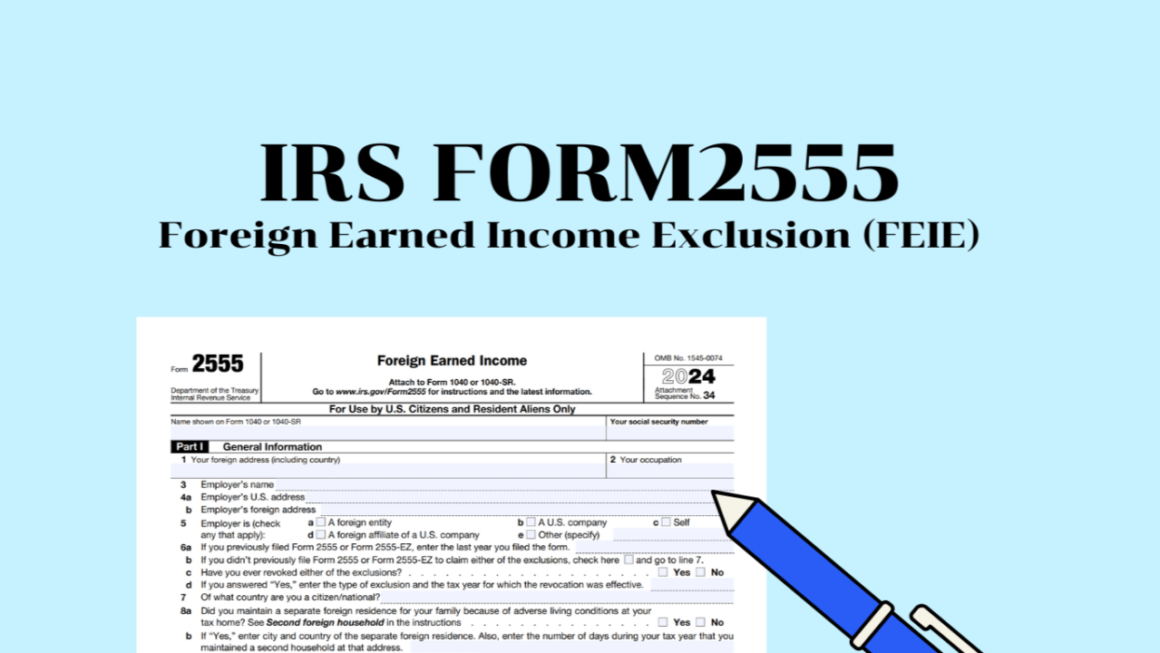
The FEIE is generally claimed by filing Form 2555 with your U.S. federal income tax return. Form 2555 is used to provide information about your foreign residence, physical presence, foreign earned income, and other details needed to determine whether you qualify.
Filing the form correctly matters because the IRS needs enough information to establish that you meet the relevant requirements. Depending on your circumstances, this can include details about your foreign address, dates of travel, employment, income, and tax home.
It is also worth keeping good records throughout the year rather than trying to reconstruct everything when tax season arrives. Travel dates, pay records, employment documents, contracts, and other supporting information can make the filing process much easier. For people who frequently travel between countries, accurate records are especially important.
What Is the Physical Presence Test?
The physical presence test is one of the most commonly discussed ways to qualify for the FEIE. Generally, you must be physically present in a foreign country or countries for at least 330 full days during a qualifying 12-month period.
The word “full” matters. The test is based on complete days, and travel days can require careful attention. A taxpayer who spends extensive time traveling between the United States and other countries should maintain a detailed travel calendar so that qualifying days can be calculated accurately.
The physical presence test does not require you to establish permanent residency in the country where you live. That makes it useful for certain expatriates, digital professionals, contractors, and others whose international living arrangements do not fit neatly into a traditional permanent-residence arrangement.
What Is the Bona Fide Residence Test?
The bona fide residence test takes a different approach. Rather than focusing primarily on a specific number of days, it considers whether you established bona fide residence in a foreign country or countries for an uninterrupted period that includes an entire tax year.
Your circumstances can matter when determining bona fide residence. Factors such as the nature of your stay, your intentions, your relationship with the foreign country, and whether you have established a genuine residence there may be relevant.
This test can be more fact-specific than the physical presence test. Someone who has moved abroad permanently for work may have a stronger bona fide residence position than someone who spends several months abroad each year while maintaining their primary life in the United States. When the facts are complicated, professional tax advice can be worthwhile.
Does the FEIE Eliminate All U.S. Taxes?
No. This is one of the most important things to understand about the Foreign Earned Income Exclusion. Claiming the FEIE does not mean an American living abroad stops being part of the U.S. tax system.
The exclusion applies to qualifying foreign earned income and has an annual limit. Other types of income may still be taxable. In addition, certain U.S. taxes, reporting requirements, and international information returns can remain relevant depending on your financial circumstances.
Self-employed taxpayers should also pay close attention to self-employment tax. The FEIE generally affects federal income tax, but it does not automatically eliminate U.S. self-employment tax. Someone who works independently overseas should therefore avoid assuming that excluding income from federal income tax also removes every possible U.S. tax obligation.
FEIE vs. Foreign Tax Credit
The Foreign Earned Income Exclusion is not the only tax provision available to Americans who pay taxes abroad. Another major provision is the Foreign Tax Credit, which can potentially provide a credit for certain foreign income taxes paid or accrued.
The two benefits work differently. The FEIE generally excludes qualifying income from U.S. federal income tax up to the applicable limit, while the Foreign Tax Credit can potentially reduce U.S. tax by allowing a credit for qualifying foreign taxes.
Choosing between these strategies can become complicated. In some situations, the FEIE may be attractive because it removes qualifying income from U.S. federal income tax. In other cases, particularly where foreign tax rates are relatively high, the Foreign Tax Credit may provide a more useful result. Some taxpayers may use both provisions, but special rules apply, and the same income cannot simply receive unlimited benefits under both systems.
Common Mistakes to Avoid
One common mistake is assuming that any income earned while outside the United States automatically qualifies. The FEIE has specific requirements, and the nature of the income and location of the services both matter. Passive income, for example, generally cannot be treated as foreign earned income simply because the taxpayer lives overseas.
Another mistake is overlooking the importance of travel records. Someone who relies on the physical presence test should know exactly how many qualifying days were spent abroad. A few days of unexpected travel can make a difference when a person is close to the required threshold.
A third mistake is assuming that the FEIE removes the need to file a U.S. tax return. U.S. citizens and resident aliens generally remain subject to U.S. reporting requirements even when living abroad. The FEIE is something you claim through the tax return; it is not an automatic exemption that happens simply because you live in another country.
Why the FEIE Matters for Americans Abroad
For qualifying taxpayers, the Foreign Earned Income Exclusion can be a valuable part of international tax planning. It can reduce the amount of foreign-earned compensation exposed to U.S. federal income tax and may make living and working internationally more financially manageable.
At the same time, the FEIE should be viewed as one piece of a larger tax picture. Americans abroad may have foreign bank accounts, investments, businesses, retirement plans, rental properties, or other financial interests that create additional U.S. reporting obligations. Local taxes in the country of residence can also affect the overall calculation.
The best approach is to understand the rules before filing rather than treating the FEIE as a simple checkbox. Keeping reliable records, understanding which income qualifies, tracking international travel, and comparing the FEIE with the Foreign Tax Credit can help you make more informed decisions.
Final Thoughts on What Is the Foreign Earned Income Exclusion
So, what is the Foreign Earned Income Exclusion? In simple terms, it is a U.S. tax provision that can allow qualifying Americans and certain resident aliens living and working abroad to exclude a specified amount of foreign earned income from U.S. federal income tax. Eligibility generally depends on having foreign earned income and meeting requirements involving your tax home and either bona fide foreign residence or physical presence abroad.
The benefit can be substantial, but it is not unlimited and does not apply to every type of income. The annual exclusion amount can change, and additional rules may apply depending on whether you are an employee, self-employed, frequently traveling, or receiving several different types of income.
If you are working outside the United States, understanding the FEIE early can save confusion later. Tax rules for Americans abroad can become surprisingly detailed, so when your situation involves substantial income, multiple countries, business ownership, or complicated investments, consulting a qualified tax professional familiar with expatriate taxation can help you avoid costly mistakes.
You May Also Raed: Englishtistic