

The conversation around weight-loss medications has changed dramatically in recent years. Drugs that were originally developed primarily for diabetes are now being studied for obesity, metabolic health, and a growing list of related conditions. Two names that frequently appear in these discussions are retatrutide vs ozempic. While they are often mentioned together, they are actually quite different medications at very different stages of development.
Ozempic contains semaglutide and works primarily by activating the GLP-1 receptor. It is an established prescription medication with an approved role in managing type 2 diabetes. Retatrutide, on the other hand, is an investigational medication being developed by Eli Lilly. It activates three hormone receptors: GIP, GLP-1, and glucagon. As of 2026, retatrutide has not been approved by the FDA and remains available only through clinical research.
That distinction matters when comparing the two. Retatrutide has generated impressive results in clinical trials, including substantial average weight loss, but those results should not be interpreted as meaning that retatrutide is currently a replacement for Ozempic. The medications have different mechanisms, evidence bases, regulatory statuses, and approved uses.
What Is Retatrutide?
Retatrutide is a once-weekly injectable medication being developed by Eli Lilly. Unlike traditional GLP-1 medications, it is designed to activate three different hormone receptors: GIP, GLP-1, and glucagon. Because of this three-way activity, researchers generally describe it as a triple agonist rather than using informal terms such as “GLP-3.” Lilly specifically notes that “GLP-3” is not an accurate scientific classification.
The idea behind retatrutide is that targeting several metabolic pathways at the same time may produce broader effects than activating GLP-1 alone. GLP-1 activity can influence appetite, food intake, and blood glucose, while GIP and glucagon pathways may contribute additional metabolic effects. Researchers are studying whether this combination can produce significant reductions in body weight and improvements in other obesity-related health measures.
Clinical development has progressed considerably. In 2026, Lilly reported positive Phase 3 results from several studies in its TRIUMPH program. In TRIUMPH-1, adults with obesity or overweight and at least one weight-related condition, but without diabetes, experienced average weight loss of up to 28.3% at 80 weeks with the 12 mg dose. These are highly significant results, although they come from a clinical-trial setting and should not be treated as proof that every future patient will experience the same outcome.
What Is Ozempic?
Ozempic is the brand name for semaglutide, a GLP-1 receptor agonist. It is an established prescription medication used to improve blood sugar control in adults with type 2 diabetes, alongside diet and exercise. Unlike retatrutide, Ozempic is an approved medicine that has already gone through the regulatory review process required for marketing.
Semaglutide works by mimicking the activity of naturally occurring GLP-1. Among other effects, GLP-1 receptor activation can increase insulin secretion when glucose levels are elevated, reduce glucagon secretion, slow gastric emptying, and influence appetite. These effects help explain why semaglutide can improve glucose control while also being associated with weight loss.
It is important, however, to distinguish Ozempic from other semaglutide products. Semaglutide is also used under different brand names and dosing regimens for specific indications, including chronic weight management. For example, the FDA approved a higher-dose Wegovy formulation in March 2026 for certain adults with obesity or overweight and at least one weight-related condition.
Retatrutide vs Ozempic: The Biggest Difference
The clearest difference between retatrutide and Ozempic is their mechanism of action. Ozempic contains semaglutide, which primarily targets one receptor: GLP-1. Retatrutide targets three receptors—GIP, GLP-1, and glucagon. This gives retatrutide a fundamentally different pharmacological profile.
That does not automatically mean that three receptors are always better than one. More biological targets can potentially create greater effects, but they can also introduce additional questions about tolerability, side effects, dosing, and long-term safety. These are precisely the issues that larger and longer clinical trials are designed to investigate.
There is also a major regulatory difference. Ozempic is an approved medicine, while retatrutide remains investigational. Lilly stated in July 2026 that it planned to submit a Biologics License Application for retatrutide to the FDA in the first quarter of 2027. Until regulatory review and approval occur, it is not appropriate to treat retatrutide as an available prescription alternative to Ozempic.
Which One Produces More Weight Loss?
This is probably the most common question people have when they search for “retatrutide vs Ozempic.” Early and Phase 3 retatrutide results have attracted considerable attention because the amount of weight loss reported in some studies has been unusually large compared with many existing obesity medications.
In the TRIUMPH-1 Phase 3 study, participants receiving 12 mg of retatrutide lost an average of 28.3% of their body weight at 80 weeks, according to Lilly’s topline results. A lower 4 mg dose produced average weight loss of 19.0% over the same period. In another Phase 3 study involving people with obesity or overweight and type 2 diabetes, the highest studied dose produced an average weight loss of 20.8% at 80 weeks.
However, comparing those figures directly with Ozempic can be misleading. Retatrutide and semaglutide have not simply been tested head-to-head in identical populations and under identical conditions. Differences in dose, trial duration, participant characteristics, background treatment, and study design can all influence the results. The most impressive number from one clinical trial should therefore not be presented as a definitive one-to-one comparison.
How Do Their Side Effects Compare?
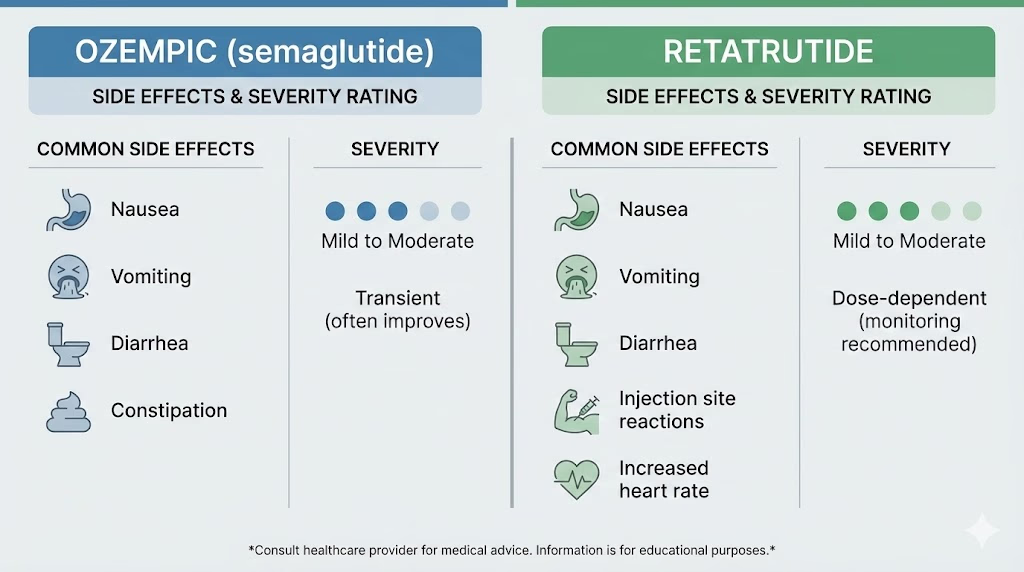
Both medications affect the gastrointestinal system, so digestive symptoms are an important part of the discussion. With GLP-1-based medicines, commonly reported adverse effects can include nausea, vomiting, diarrhea, constipation, and abdominal discomfort. These symptoms can be particularly noticeable when treatment is started or doses are increased.
Because retatrutide activates three metabolic pathways rather than one, researchers are paying close attention to its safety and tolerability profile. Clinical trials have reported gastrointestinal adverse events, and dose escalation is an important part of how investigational retatrutide regimens are studied. Still, the complete long-term safety profile cannot be considered established until the broader development program and regulatory review are completed.
Patients should also be careful with products claiming to contain retatrutide outside legitimate clinical trials. The FDA has specifically warned that retatrutide cannot be used in compounding under federal law and that it is not an ingredient in an FDA-approved medication. Unapproved products may have uncertain identity, strength, purity, or sterility.
Is Retatrutide Better Than Ozempic?
It is tempting to answer “yes” simply because retatrutide has produced impressive trial results. But a responsible answer is more complicated. Retatrutide may eventually become an important treatment option if its clinical-trial results translate into approved indications and its safety profile proves acceptable over the long term.
Ozempic has a major advantage that retatrutide currently does not: established regulatory approval and years of clinical experience. Doctors have prescribing information, safety data, dosing guidance, and real-world experience to work with. That makes the decision surrounding Ozempic considerably different from the decision surrounding an investigational compound.
There is also no reason to assume that the medication producing the greatest average weight loss in a study will automatically be the best choice for every individual. Treatment decisions depend on a person’s medical history, diabetes status, other medications, side-effect tolerance, treatment goals, contraindications, and access to care. A medication’s effectiveness is only one part of the equation.
Retatrutide vs Ozempic for Type 2 Diabetes
Ozempic has a well-established role in type 2 diabetes management. Semaglutide’s GLP-1 receptor activity helps improve blood glucose control and can contribute to weight reduction. For someone whose primary concern is type 2 diabetes, its established approval and clinical experience are important considerations.
Retatrutide is also being investigated for type 2 diabetes. In the Phase 3 TRANSCEND-T2D-1 study, Lilly reported A1C reductions of up to 2.0% and weight loss of up to 16.8% at 40 weeks. The results indicate that the medication could have substantial effects on both glycemic control and body weight, although regulatory decisions will ultimately depend on the complete evidence package.
The distinction between promising research and established treatment is especially important for diabetes. People should not stop, switch, or combine prescription diabetes medications based solely on online comparisons. A treatment that looks impressive in a clinical-trial headline still needs to be evaluated in the context of an individual patient’s glucose control, other medications, kidney function, cardiovascular risk, and overall health.
What About Weight-Loss Goals?
For people primarily interested in weight management, retatrutide is attracting attention because of the magnitude of weight loss reported in trials. The 28.3% average reduction reported in TRIUMPH-1 at 80 weeks is considerably larger than the kind of result many people associate with older weight-loss medications.
But the word “average” is important. Clinical-trial averages do not predict exactly what one individual will lose. Some participants lose more, others lose less, and some discontinue treatment. Weight-loss results can also be affected by dietary habits, physical activity, adherence, underlying medical conditions, and the ability to remain on treatment.
For now, the practical difference is simple: approved semaglutide products are already part of modern obesity treatment, while retatrutide represents a potential future option. If retatrutide ultimately receives regulatory approval, clinicians will have more evidence to determine exactly where it fits among GLP-1 and other metabolic therapies.
Why Retatrutide Has Created So Much Excitement
One reason retatrutide has generated so much interest is the possibility that targeting multiple metabolic pathways could push pharmacological weight management to a new level. The Phase 3 results released in 2026 have strengthened that interest, particularly because positive findings have appeared across several obesity-related conditions.
Lilly has reported studies examining retatrutide not only for obesity but also for conditions such as type 2 diabetes, knee osteoarthritis pain, obstructive sleep apnea, cardiovascular and renal outcomes, and metabolic dysfunction-associated steatotic liver disease. This broader development program reflects the growing understanding that obesity is closely connected with multiple chronic diseases rather than being simply a matter of body weight.
Still, excitement should not be confused with approval. Retatrutide remains an investigational medication. Even highly positive Phase 3 findings must go through regulatory review before a drug can become an approved treatment for the public. That process exists to evaluate whether the benefits outweigh the risks for the proposed uses.
Should You Choose Retatrutide or Ozempic?
For most people today, this is not actually a choice between two equivalent prescription options. Ozempic is an established medication, while retatrutide remains under investigation. Someone considering treatment should therefore discuss currently approved options with a qualified healthcare professional rather than attempting to obtain experimental retatrutide independently.
If retatrutide is eventually approved, the decision will become more interesting. Doctors will be able to compare its approved indications, dosing schedules, efficacy, adverse effects, long-term safety information, and real-world performance with existing medications such as semaglutide.
Cost and availability may also become important. The price and insurance coverage of any future retatrutide product cannot be known with certainty until the regulatory and commercial process is complete. For now, online sellers offering “retatrutide” should be approached with extreme caution because products sold outside legitimate clinical research are not equivalent to an FDA-approved prescription medication.
The Bottom Line on Retatrutide vs Ozempic
The retatrutide vs Ozempic comparison is ultimately a comparison between an established GLP-1 medication and an investigational triple-receptor therapy. Ozempic’s active ingredient, semaglutide, primarily activates the GLP-1 receptor and has an established role in type 2 diabetes treatment. Retatrutide activates GIP, GLP-1, and glucagon receptors and is being investigated for obesity, diabetes, and several related conditions.
Retatrutide’s clinical results are certainly impressive. Phase 3 data reported in 2026 showed substantial weight loss, including an average reduction of 28.3% at 80 weeks with the 12 mg dose in TRIUMPH-1. However, those findings should not be interpreted as a direct promise of future results for every patient or as proof that retatrutide is already superior to Ozempic.
The most important takeaway is that retatrutide is not currently an FDA-approved alternative to Ozempic. As of 2026, it remains investigational, with Lilly planning a regulatory submission in 2027. Until approval and additional independent clinical evidence are available, people should rely on approved treatments and professional medical guidance rather than purchasing unapproved retatrutide products online.
You May Also Raed: Englishtistic