

Key Takeaways
- Affordable tree work means complete, safe value, not simply the lowest estimate.
- Tree size, damage, location, equipment access, cleanup, and urgency all affect the final scope of work.
- Pruning and early risk assessments can sometimes cost less than waiting for a hazardous tree to fail.
- Southwest Indiana storms, saturated ground, rural access roads, barns, fences, and utility lines all require careful planning.
- A clear written estimate helps property owners compare services fairly.
For homeowners, farmers, landlords, and business owners, affordable tree care is about paying for the right solution without accepting avoidable risks. GE Tree Service in Southwest Indiana helps property owners look beyond a single number and consider the full value of professional removal, trimming, storm response, stump grinding, and tree-health services.
In and around Petersburg, a tree may stand in an open field, beside a century-old home, over a driveway, near a barn, or along a narrow rural lane. Those circumstances matter. A low estimate that leaves debris behind, excludes difficult-access work, or fails to account for safety around structures may not be affordable once the true costs and risks are considered. The best starting point is a practical conversation about the tree, the property, and the desired result after the work is complete.
Affordable Does Not Always Mean Cheapest
The lowest bid can look attractive when a large limb is hanging over a roof or a dead tree is leaning toward a fence. However, tree work is not a one-size-fits-all service. A responsible estimate should account for the tree’s condition, the surroundings, the crew’s equipment needs, labor, disposal, and site cleanup.
For example, removing a small tree in an open yard may be straightforward. Removing a mature oak above a garage, livestock enclosure, septic area, or power line requires a much different plan. Controlled rigging, aerial lifts, cranes, additional ground protection, and skilled crew coordination may be necessary to avoid damage. That preparation is part of the value, not an unnecessary extra.
It is also helpful to distinguish between a quote that is genuinely more efficient and one that is simply incomplete. A company may be able to offer a competitive price because it has the right equipment, an organized crew, and a clear process. By contrast, an estimate may appear inexpensive because it does not include hauling, brush chipping, final raking, or the extra labor required to work safely around obstacles.
What a Complete Estimate Should Clarify
- Whether the recommendation is pruning, removal, treatment, monitoring, or stump work.
- How branches, logs, chips, and debris will be handled.
- Whether access limitations affect equipment or labor requirements.
- Whether cleanup, hauling, and stump grinding are included.
- Whether the tree presents an urgent risk to people, buildings, vehicles, or utilities.
- Whether the quoted price reflects one tree, multiple trees, or only the specifically identified limbs.
Why Tree Work Costs Vary Across Southwest Indiana
Southwest Indiana properties range from compact residential lots in town to wooded acreage, agricultural land, commercial parcels, and homes with long gravel driveways. Local weather adds another layer. Heavy rain can leave the soil soft and difficult for equipment. Summer storms can split limbs or weaken root systems. Ice, wind, and repeated wet-dry cycles can expose issues that were not obvious a season earlier.
Tree height and diameter matter, but so does where the tree can fall. A healthy-looking tree beside a home may still require careful removal because of its proximity to windows, roofs, sheds, landscaping, and utility service lines. Likewise, a storm-damaged tree can be unpredictable when broken limbs are suspended in the canopy or when the trunk has shifted at the base.
Access can also substantially change the plan. A crew may need to work through a narrow gate, around a pond, across uneven ground, or beside crop fields and outbuildings. Identifying those conditions before work begins helps avoid surprises and lets the property owner understand why a job may require additional time, specialized machinery, or manual removal methods.
Safety Is a Major Part of the Value
Professional tree work involves chainsaws, elevated work, felling trees, chippers, heavy machinery, and potential electrical hazards. The Occupational Safety and Health Administration’s tree-care guidance identifies overhead lines, falling branches, equipment failures, falls, and struck-by hazards as serious concerns in the industry. A price that ignores those realities can become expensive very quickly if property damage or injuries occur.
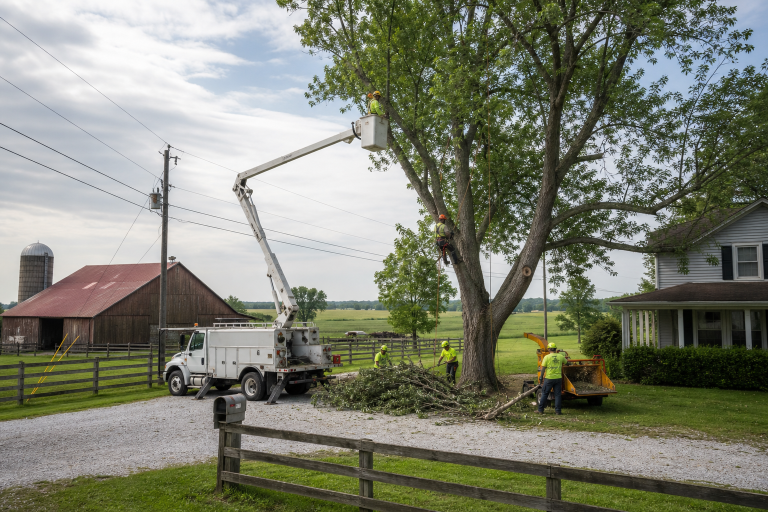
Before hiring a crew, property owners should ask about insurance, safety procedures, site protection, and experience with difficult removals. It is also reasonable to ask how the crew will establish a drop zone, protect nearby structures, manage traffic and driveway access, and address utility line concerns.
Property owners can also make the work area safer by moving vehicles, lawn furniture, equipment, and animals away from the planned work zone when possible. Providing clear access to gates, driveways, and the tree location can help the crew work efficiently while reducing the chance of accidental damage to personal property.
Questions Worth Asking Before Work Begins
- Has someone evaluated the tree and the site in person?
- Is the company insured for the work being performed?
- What equipment will be used for confined or hazardous locations?
- Will cleanup and hauling be included in the written scope?
- Can logs be removed, cut into manageable pieces, or left when appropriate?
- How will the crew protect lawns, driveways, fences, and nearby buildings?
When Trimming Can Be More Affordable Than Removal
Not every overgrown or damaged-looking tree needs to come down. Strategic pruning may remove dead limbs, reduce weight on an extended branch, improve clearance above a driveway, or address branches rubbing against a structure. When performed at the right time and for the right reason, pruning can help preserve a structurally sound tree while reducing certain risks.
On the other hand, severe decay, major trunk cracks, root damage, a worsening lean, or a compromised base may call for removal. The affordable decision is the one based on the tree’s actual condition, not guesswork. An on-site evaluation can help a property owner avoid paying for unnecessary removal or delaying action on a genuine hazard.
Regular trimming can also improve practical access around a property. Clearance for delivery vehicles, farm equipment, sidewalks, roofs, signs, and outdoor lighting can often be addressed before branches become a larger problem. The goal is not to over-prune a tree, but to make targeted cuts that fit the tree’s condition and the property’s needs.
Long-Term Tree Care Can Reduce Surprise Expenses
Routine attention does not guarantee that a tree will never fail in a storm, but it can give property owners more time to make informed decisions. Watching for dead limbs, cavities, fungal growth near the base, exposed roots, branch unions with visible cracks, or changes in lean can help identify concerns before an emergency develops.
Healthy trees also offer practical benefits in Southwest Indiana. Shade can make outdoor spaces more comfortable, and a tree canopy can help intercept rainfall before it reaches the ground. A U.S. Forest Service study found that removing street trees increased measured surface runoff in the study area, illustrating why thoughtful tree preservation and planting can matter for more than curb appeal.
Seasonal walk-throughs are often a simple way to stay ahead of problems. Checking trees after high winds, heavy snow, construction activity, or prolonged wet weather can reveal changes in branch condition or soil movement near the base. Addressing a concern while access is easier may be less disruptive than scheduling emergency work after a failure.
Storm Damage Requires a Different Kind of Planning
After a severe thunderstorm or ice event, urgency can change the scope of tree work. A fallen tree blocking a driveway, a limb on a roof, or a tree touching utility equipment may need immediate attention. In those situations, safety and stabilization come first, followed by cleanup and any needed documentation for an insurance claim.
Keep people, pets, and vehicles away from damaged trees. Never approach a branch or trunk that may be in contact with a power line. Take photographs from a safe distance, contact the utility provider when lines are involved, and preserve relevant evidence before discarding major debris when practical.
Even when a damaged tree remains standing, it should not automatically be considered safe. Broken tops, cracked limbs, and partially uprooted root systems can fail later, especially during the next period of wind or rain. A prompt professional assessment can help determine whether the tree can be pruned and monitored or whether removal is the safer option.
Comparing Tree-Service Quotes the Smart Way
When reviewing estimates, compare the scope rather than the total alone. A slightly higher quote may include debris removal, safer equipment, experienced labor, stump grinding, or protection for tight spaces. A lower quote may exclude one or more of those items.
- Compare service: Is each company recommending the same work?
- Compare cleanup: Are chips, logs, branches, and raking included?
- Compare access: Does the quote reflect gates, fences, soft ground, or narrow driveways?
- Compare risk: Is the crew equipped for work near homes, barns, or utilities?
- Compare timing: Is the work routine maintenance or an emergency response?
Ask for clarification before accepting an estimate if a detail is unclear. Knowing whether stump grinding is separate, whether firewood-length cuts are available, and whether the crew will remove all material from the site makes it easier to compare quotes fairly. Written expectations protect both the customer and the service provider.
Local Help for Residential, Farm, and Commercial Properties
Whether the job involves a dead backyard tree in Petersburg, storm cleanup on rural property, trimming near a barn, stump grinding before a landscape project, or land clearing for future use, affordability begins with a clear plan. The best value is work that addresses the tree’s actual condition, protects the property, and leaves the site in the condition you expect.
Every property has different priorities. One owner may need a driveway reopened quickly, while another may be planning a building project, improving a rental property, or protecting a favorite shade tree. Explaining those priorities during an evaluation helps ensure that the recommended work aligns with the property’s short-term needs and long-term goals.
Location: GE Tree Service | 1202 Spruce St, Petersburg, IN 47567 | (812) 354-6119.
Final Thought
Affordable tree work in Southwest Indiana means making a practical investment in safety, clear communication, proper equipment, and complete service. Instead of choosing only by the lowest number, choose a tree-care plan that explains what is being done, why it is needed, and what will be left behind when the crew is finished.