

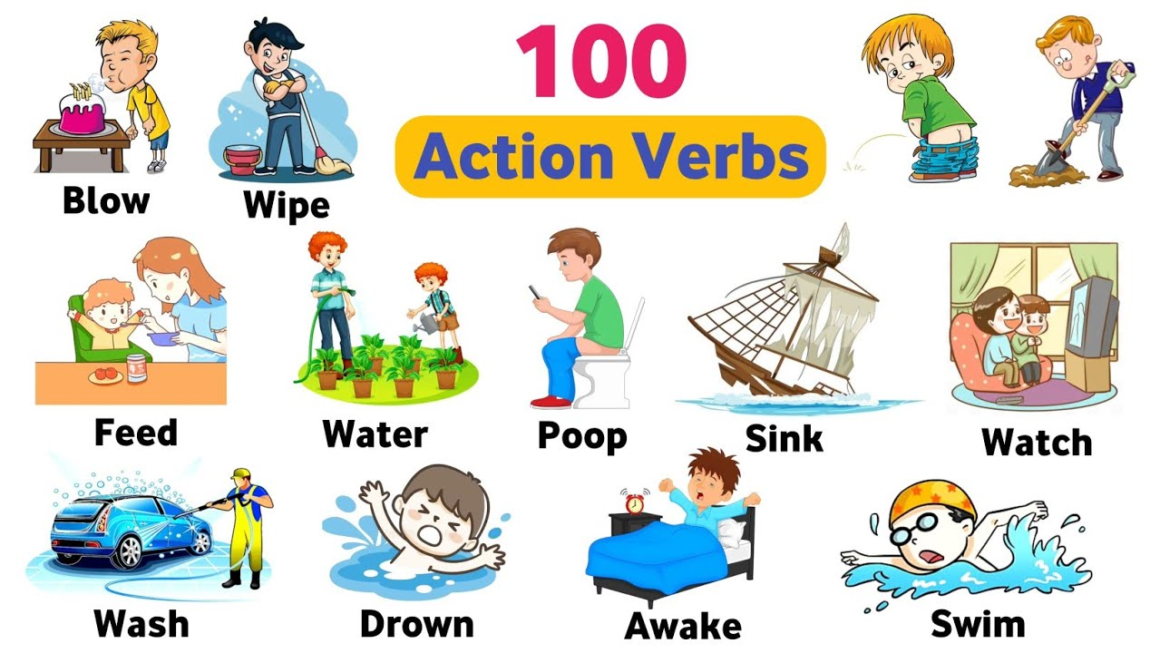
Learning English becomes much easier when you understand how to use strong and useful action words. Action words, also called action verbs, describe what someone or something does. Words such as run, write, jump, speak, and create can make sentences clearer because they show an activity or movement.
For students, writers, professionals, and anyone improving their English, having a strong collection of action words can make communication more natural. Instead of using the same basic verbs repeatedly, you can choose words that explain exactly what is happening.
In this guide, you will find 100 action words in English, along with simple explanations and examples. The goal is not only to memorize the words but also to understand how they work in everyday sentences.
What Are Action Words in English?
Action words are verbs that show an activity, movement, or action performed by a person, animal, object, or even an idea. For example, in the sentence, “Sarah opened the door,” the word opened tells us exactly what Sarah did. It gives the sentence energy and meaning.
Action words can describe physical activities, such as walk, swim, and climb. They can also describe mental or communication activities, such as think, decide, explain, and remember. This means that action verbs are not limited to things we can physically see.
Using the right action word can make your English more precise. Compare “He went quickly” with “He sprinted.” Both sentences describe movement, but sprinted gives the reader a much clearer picture of the action.
100 Action Words in English
Here is a practical list of 100 common and useful action words in English. These verbs are suitable for everyday conversations, school assignments, creative writing, professional communication, and general English practice.
- Run — to move quickly on foot.
The children run across the field. - Walk — to move on foot at a normal pace.
I walk to school every morning. - Jump — to push yourself into the air.
The athlete jumped over the barrier. - Swim — to move through water.
They swim in the pool every weekend. - Climb — to move upward using your hands and feet.
We climbed the mountain carefully. - Crawl — to move close to the ground.
The baby crawled across the floor. - Dance — to move your body rhythmically.
Everyone danced to the music. - Sing — to produce musical sounds with your voice.
She sings beautifully. - Speak — to communicate using your voice.
He speaks English confidently. - Talk — to communicate with another person.
We talked about the new project. - Write — to form words using letters or symbols.
She writes in her notebook. - Read — to understand written words.
I read a book before bed. - Draw — to create a picture using lines.
The student drew a beautiful picture. - Paint — to create an image using paint.
They painted the wall yesterday. - Build — to construct something.
Workers built a new bridge. - Create — to make something new.
She created an interesting design. - Make — to produce or prepare something.
He made breakfast for everyone. - Cook — to prepare food using heat.
My father cooks dinner every evening. - Bake — to cook food in an oven.
She baked a chocolate cake. - Cut — to divide something with a sharp tool.
Please cut the paper carefully. - Open — to move something so that it is no longer closed.
He opened the window. - Close — to shut something.
Please close the door. - Push — to move something away from you.
She pushed the box across the room. - Pull — to move something toward you.
He pulled the handle. - Carry — to hold and move something.
I carried the bags upstairs. - Throw — to send something through the air.
He threw the ball to his friend. - Catch — to stop and hold something moving through the air.
She caught the ball easily. - Kick — to hit something with your foot.
The player kicked the ball. - Hit — to strike something or someone.
The hammer hit the nail. - Lift — to raise something upward.
He lifted the heavy box. - Move — to change position.
Please move the chair. - Drive — to control a vehicle.
She drives to work every day. - Ride — to travel on or in something.
He rides his bicycle to school. - Fly — to move through the air.
Birds fly across the sky. - Travel — to go from one place to another.
They travel frequently for work. - Explore — to travel around and discover something.
We explored the old city. - Search — to look carefully for something.
The detective searched the room. - Find — to discover or locate something.
I found my keys. - Look — to direct your eyes toward something.
Look at the beautiful sunset. - Watch — to observe something for a period of time.
We watched a movie last night. - Listen — to pay attention to sound.
Listen to your teacher carefully. - Hear — to perceive a sound.
I heard a strange noise. - See — to notice something with your eyes.
She saw a bird outside. - Touch — to make contact with something.
Do not touch the hot pan. - Hold — to keep something in your hands.
Hold the cup carefully. - Give — to provide something to someone.
She gave me a useful book. - Take — to move or receive something.
Please take this message to him. - Bring — to carry something toward a place or person.
Bring your notebook tomorrow. - Send — to cause something to go to another person or place.
I sent the email this morning. - Receive — to get something that is given or sent.
We received your letter. - Buy — to get something by paying money.
He bought a new phone. - Sell — to exchange something for money.
They sell fresh vegetables. - Pay — to give money for something.
I paid the bill. - Choose — to select something.
She chose the blue dress. - Decide — to make a choice after thinking.
We decided to start early. - Plan — to organize what you intend to do.
They planned their trip carefully. - Organize — to arrange things systematically.
She organized the files. - Prepare — to make something ready.
He prepared for the examination. - Learn — to gain knowledge or skill.
Children learn quickly. - Teach — to help someone gain knowledge or skills.
She teaches English online. - Study — to spend time learning about something.
I study English every evening. - Practice — to repeat an activity to improve.
He practices speaking English daily. - Understand — to know the meaning of something.
I understand the question. - Remember — to keep information in your mind.
Remember to call your mother. - Forget — to fail to remember something.
I forgot my appointment. - Think — to use your mind to consider something.
Think carefully before answering. - Imagine — to create an idea or picture in your mind.
Imagine living beside the ocean. - Solve — to find an answer to a problem.
The student solved the difficult question. - Explain — to make something clear.
The teacher explained the lesson. - Ask — to request information or an answer.
She asked an important question. - Answer — to respond to a question.
He answered correctly. - Discuss — to talk about something in detail.
The team discussed the problem. - Share — to give part of something to others.
They shared their ideas. - Help — to assist someone.
Can you help me with this task? - Support — to help someone or something succeed.
Her family supported her decision. - Protect — to keep someone or something safe.
Parents protect their children. - Save — to prevent something from being lost or damaged.
We should save important documents. - Fix — to repair something.
He fixed the broken chair. - Clean — to remove dirt from something.
She cleaned the kitchen. - Wash — to clean using water.
Wash your hands before eating. - Break — to damage something or separate it into pieces.
Be careful not to break the glass. - Repair — to restore something that is damaged.
The mechanic repaired the car. - Change — to make something different.
We changed our plans. - Improve — to make something better.
Practice can improve your English. - Grow — to become larger or develop.
Plants grow quickly in sunlight. - Plant — to put a seed or plant into the ground.
They planted trees in the garden. - Water — to give water to plants or something that needs it.
I water the flowers every morning. - Work — to perform a job or activity.
She works from home. - Start — to begin something.
The class starts at nine. - Finish — to complete something.
He finished his homework. - Win — to achieve victory.
Our team won the match. - Compete — to try to win against others.
Several athletes competed in the race. - Lead — to guide a person or group.
She leads the project. - Follow — to go after someone or obey instructions.
Follow the directions carefully. - Reach — to arrive at or achieve something.
We reached the station on time. - Build — to construct or develop something.
They built a successful business. - Develop — to grow, improve, or create something over time.
He developed a useful skill. - Discover — to find something previously unknown.
Scientists discovered a new method. - Achieve — to successfully reach a goal.
She achieved her dream. - Celebrate — to show happiness about an achievement or event.
The family celebrated her success.
Why Action Words Are Important in English
Action words make sentences more direct and meaningful. When you use a specific verb, readers and listeners can understand the situation without needing unnecessary explanation. For example, “The boy ran toward the bus” is more vivid than saying “The boy went toward the bus quickly.”
They are especially useful when writing stories, essays, blog posts, reports, and descriptions. Strong verbs can give writing movement and personality. Instead of repeatedly using general words such as do, go, or make, you can choose more precise alternatives that communicate the exact action.
Action verbs are also important in everyday conversation. Whether you are explaining your routine, describing your job, talking about sports, or discussing your plans, you naturally depend on verbs. Improving your action-word vocabulary can therefore make both spoken and written English more confident.
How to Learn These 100 Action Words Faster
One of the best ways to learn action words is to use them in your own sentences. Memorizing a long list can be useful at first, but vocabulary becomes much easier to remember when you connect each word with a real situation. For example, when you learn carry, think about carrying a bag or a book.
Another effective method is to group words by meaning. You can study movement words such as run, walk, jump, and climb together. Then learn communication words such as speak, talk, ask, answer, and explain. Grouping related verbs creates connections in your memory.
It is also helpful to practice the same verb in different tenses. For example, you can say, “I write every day,” “I wrote yesterday,” and “I will write tomorrow.” This approach teaches vocabulary and grammar at the same time, making your English more flexible.
Using Action Words in Everyday Sentences
Action words appear in almost every normal conversation. When describing your morning, you might say, “I wake up, wash my face, eat breakfast, and drive to work.” Each verb helps the listener understand what happens in sequence.
At school or work, action verbs can make instructions clearer. You might hear phrases such as “read the document,” “write a report,” “check the information,” “discuss the problem,” or “complete the task.” These verbs tell people exactly what they need to do.
You can also use action words to make personal goals sound stronger. Instead of saying, “I want to get better at English,” you can say, “I practice English every day and improve my vocabulary.” The second sentence focuses on action, which makes the goal sound more practical and achievable.
Action Words for Better Writing
Good writing is often about choosing precise words. A sentence becomes more interesting when the verb clearly communicates what is happening. For instance, “The dog moved quickly” is understandable, but “The dog sprinted across the yard” creates a much stronger image.
Writers should avoid relying too heavily on vague verbs. Words such as do, get, and go are useful, but they cannot always communicate the exact meaning. Replacing them with verbs such as create, achieve, discover, explore, or complete can make your writing more informative.
However, strong writing does not mean using complicated words everywhere. The best action word is usually the one that fits naturally and accurately. Simple verbs such as walk, read, write, and help are powerful because they are clear and familiar.
Common Mistakes When Using Action Words
One common mistake is choosing a verb that does not match the intended meaning. For example, hear and listen are related but not identical. You can hear a sound without deliberately paying attention to it, while listening normally involves intentional attention.
Another mistake is forgetting to change the verb correctly when the subject or tense changes. For example, “She walks to school” is correct, while “She walk to school” is incorrect in standard English. Learning action words alongside their basic grammar patterns can prevent these errors.
A final mistake is repeating the same verb too often. If every sentence uses go, the writing may sound dull. Learning alternatives such as travel, walk, move, explore, and reach gives you more control over your language while keeping your sentences natural.
Final Thoughts on 100 Action Words in English
Learning these 100 action words is a practical step toward stronger English vocabulary. These verbs cover movement, communication, learning, thinking, working, creating, and many other activities that appear in everyday life. Once you understand their meanings, you can begin using them naturally in conversations and writing.
The most effective way to remember them is through regular practice. Choose five or ten words each day and create original sentences with them. Try using them while describing your routine, writing a short story, talking with someone, or keeping a personal journal.
Most importantly, do not worry about learning all 100 words at once. Vocabulary develops gradually through repetition and real use. When you consistently practice action words and pay attention to how native English speakers use them, your sentences will become clearer, more expressive, and more confident.
You May Also Raed: Englishtistic